
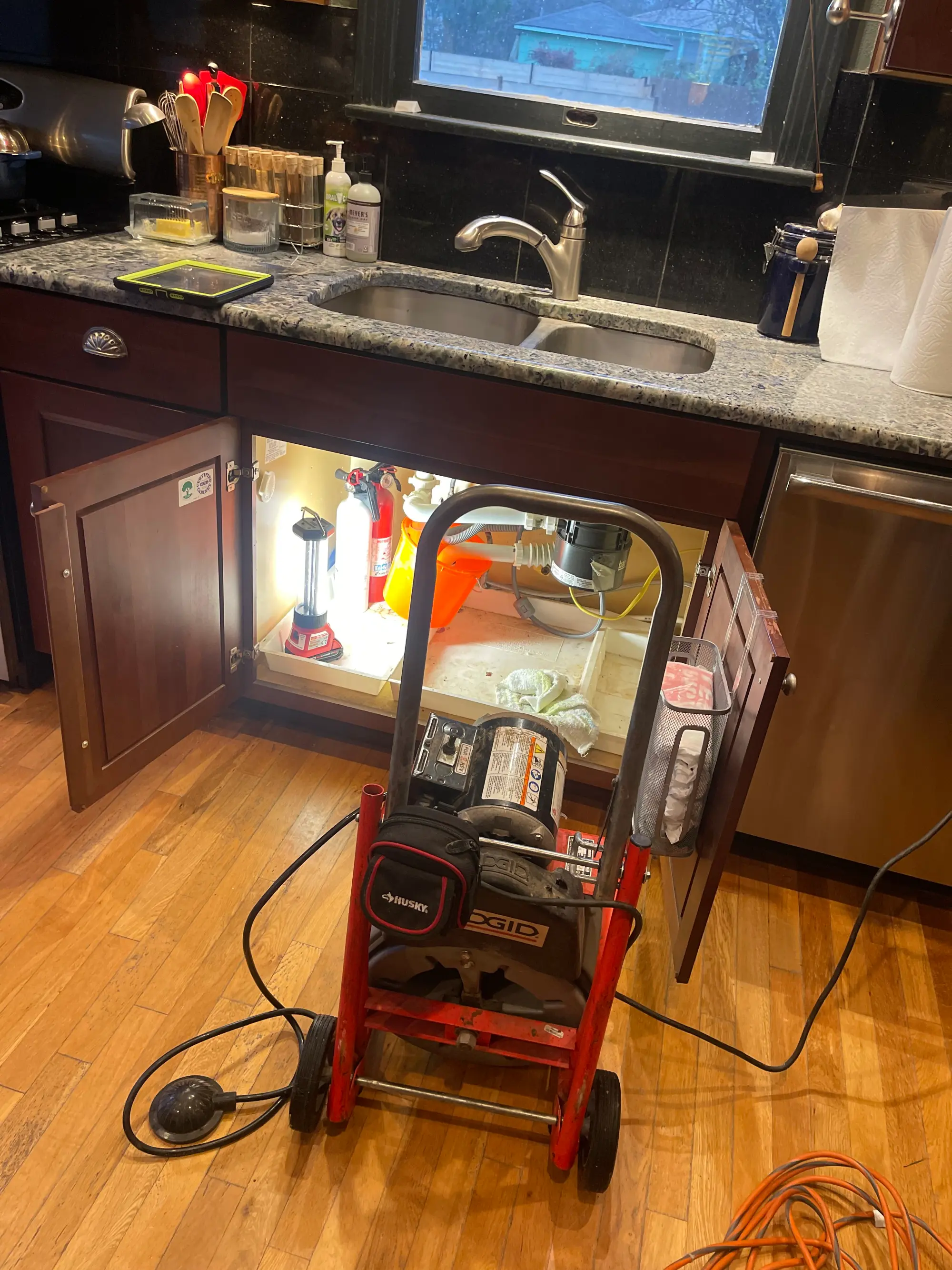
Tree roots are the leading cause of sewer line failure in mature neighborhoods. They find their way in through joints, hairline cracks, and weak spots in old clay or cast iron pipe, then grow steadily because the inside of the line offers exactly what a tree wants: water, oxygen, and dissolved nutrients. Round Rock's mature live oaks, cedar elms, and pecans are particularly aggressive root systems.
If your home is more than 25 years old and you have trees within 20 feet of the sewer line, root intrusion is a question of when, not if.
How Roots Get Into a Sewer Pipe
Sewer pipes are designed to be watertight, but no system is perfect over decades:
- Joints — older clay and cast iron pipe used short sections joined with gaskets or mortar. As those seals degrade, roots find the gap.
- Hairline cracks — ground movement, settling, and Round Rock's expansive clay soil flex pipes. A crack invisible to the eye is enough for a root tip to enter.
- Offset pipe sections — when a pipe section shifts even a quarter inch, roots invade the offset.
- Broken pipe — once a root has wedged a joint open, water and waste leak into the surrounding soil, attracting more roots.
Once inside, the root mass grows in the direction of flow, branches out at every joint, and over time creates a fibrous mat that catches paper, grease, and wipes. That is when you start backing up.
Warning Signs You Have Roots in the Line
Most homeowners notice symptoms gradually:
- Toilets that gurgle when you run the bathroom sink or shower
- Frequent main-line clogs (more than once every 18 months)
- Slow draining throughout the house, not just one fixture
- Lush, faster-growing grass over the sewer line route
- Soggy or sunken patches in the yard along the line
- Sewage smell in the yard, especially after rain
If you have any combination of these, get a sewer camera inspection before you have a full backup.
Confirming It With a Camera
A sewer camera is a flexible fiber-optic cable with a self-leveling head that we feed down the line from the cleanout. We can see exactly what is in the pipe in real time and record video for you. Roots are unmistakable — they look like coral or a beard hanging into the flow path. The camera also tells us:
- Where the intrusion is (depth and distance from the cleanout)
- How widespread it is (one joint or multiple)
- Whether the pipe is still structurally sound or already cracked open
- What pipe material we are dealing with
Without a camera, every root-removal call is guesswork.
The Four Fix Options
1. Mechanical Root Cutting (Snake with a Cutter Head)
A specialized snake with a rotating cutter head shears the roots flush with the inside of the pipe. Cheapest option ($350-600). The problem: roots grow back. You buy yourself 6-18 months depending on the species and the size of the entry point.
Right call when: budget is tight, the pipe is otherwise sound, and you want to delay a bigger fix.
2. Hydro Jetting With Root-Cutting Nozzle
A hydro jet using a specialized chain-tip or root-cutting nozzle blasts roots out and flushes the debris away. More thorough than mechanical cutting because it also clears the scale and biofilm that catches debris. Typical cost $600-1,200 with camera. Buys you 18-36 months in most cases.
Right call when: roots are present but the pipe is still structurally sound and you want maximum time between visits.
3. Foaming Root Killer (Maintenance Chemical)
Foaming RootX or Roebic treatments are pumped into the line as a foam that fills the pipe and contacts the roots above the waterline. They kill the root surface back several feet from the pipe and discourage regrowth. Used as periodic maintenance after a jetting, not as a primary fix.
Right call when: combined with a recent jetting, to extend the clear interval.
4. Pipe Replacement (Spot Repair or Trenchless)
If the camera shows the pipe is cracked, offset, or has multiple entry points across many joints, you are past maintenance territory. Options:
- Spot repair — dig down to the bad section, cut out 4-8 feet of pipe, and replace. $1,500-4,500.
- Trenchless pipe lining (CIPP) — a resin-saturated felt liner is pulled through the existing pipe and cured in place. Creates a new pipe within the old one. No major excavation. $80-250 per foot.
- Pipe bursting — a bursting head pulls a new HDPE pipe through the old one, fragmenting the original. $90-200 per foot.
- Full traditional replacement — open trench, replace the line. $50-150 per foot.
Read more on trenchless options or pipe replacement.
Why Root Intrusion Is So Common in Round Rock
Three factors:
- Soil. Round Rock sits on expansive Blackland clay. The soil swells when wet and shrinks when dry, stressing buried pipes and creating the cracks roots exploit.
- Tree species. Live oaks, cedar elms, pecans, and ash all have aggressive water-seeking root systems. Many older Round Rock subdivisions were planted heavily with these — the mature canopies you see throughout Vista Oaks, Cat Hollow, and the Brushy Creek area are gorgeous and also the leading source of sewer line intrusion we see in those neighborhoods.
- Pipe age. Homes built before the mid-1990s often have clay tile or cast iron sewer pipe — both vulnerable to root intrusion at joints.
What You Can Do as a Homeowner
- Know where your sewer line runs and avoid planting new trees within 10 feet of it
- If you have aggressive species near the line, schedule a camera every 2-3 years
- Treat with foaming root killer every 6 months in lines you know have root pressure
- Schedule preventive jetting every 24 months if your line has been treated before
Service Across Williamson County
We diagnose and treat root-infiltrated sewer lines throughout Round Rock, Cedar Park, Pflugerville, Georgetown, Hutto, and Leander. Every root call starts with a camera so we recommend the right level of fix.
Related Articles
Need Professional Plumbing Help?
Our licensed plumbers are ready to help with any plumbing issue. Contact us today for fast, reliable service.
Call (512) 598-4241