
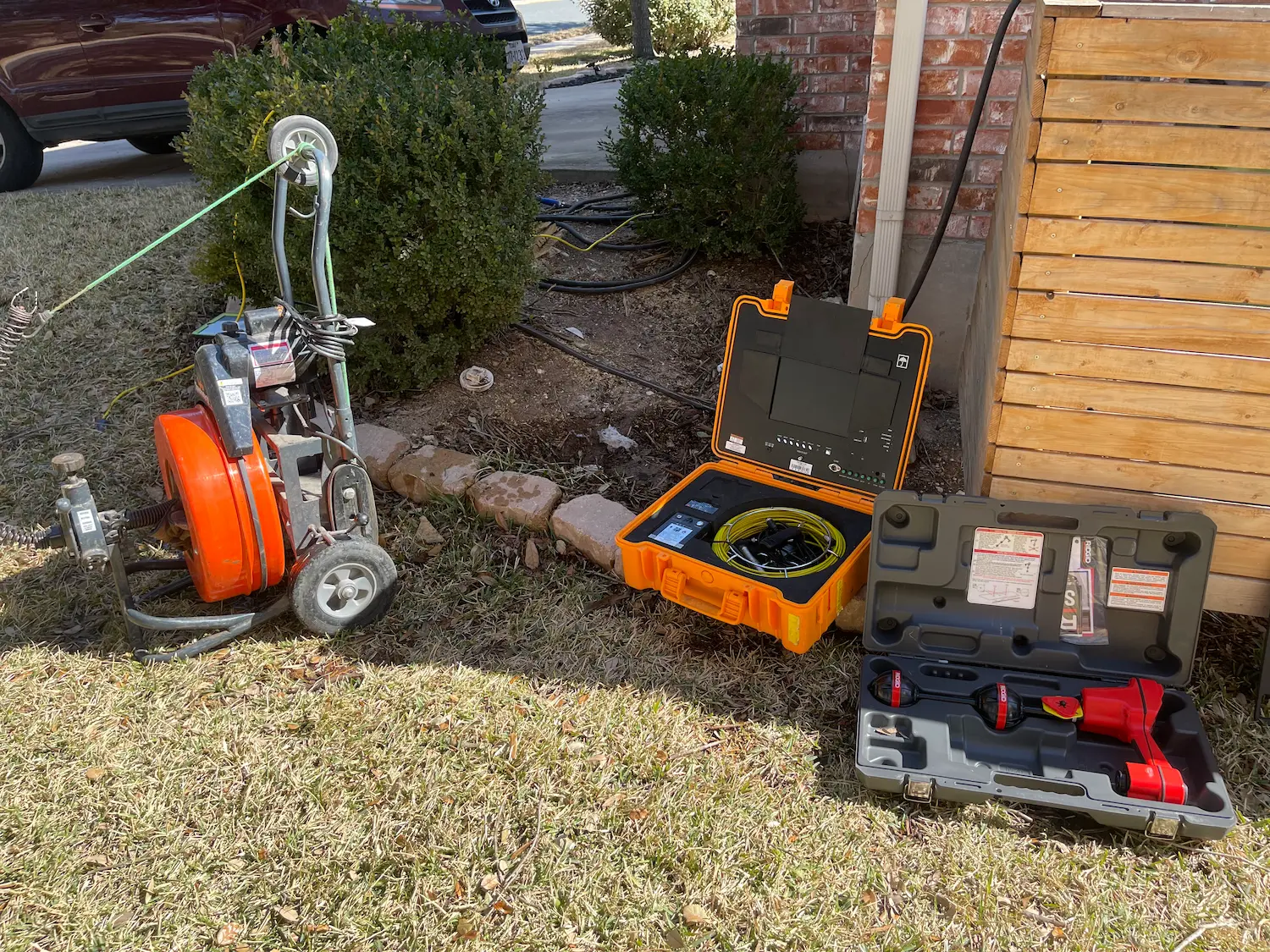
Trenchless sewer repair is a category of sewer line fixes that does not require digging an open trench across your yard from the house to the city tap. The two methods — pipe lining (also called CIPP, for "cured in place pipe") and pipe bursting — both create a new pipe along the existing route while sparing your lawn, driveway, sidewalks, and landscaping.
For most Round Rock homes with damaged but not collapsed sewer lines, trenchless is faster, cleaner, and similarly priced or even cheaper than open-trench excavation once you factor in the cost of restoring everything that gets dug up.
Why Trenchless Exists
Traditional sewer line replacement means digging a trench 3-6 feet deep from your home's foundation out to the city tap at the street. That is typically a 40-80 foot trench through landscaping, irrigation lines, driveways, sometimes mature trees, and occasionally a section of concrete patio.
The pipe portion of that job is usually a small fraction of the total cost. The bulk goes to excavation, soil removal, restoration, and time. Trenchless eliminates most of that.
Method 1: Pipe Lining (CIPP)
The "cured in place pipe" method:
- We locate and clear the existing line via hydro jetting and camera inspection
- We open a single access point (usually the cleanout or a small dig at the line end)
- A flexible liner saturated with epoxy resin is inverted into the pipe by water or air pressure
- The liner cures in place — usually 2-4 hours with hot water or UV light
- Once cured, the result is a seamless, jointless new pipe inside the old one
The new lined pipe has a slightly smaller inside diameter (about 1/4 to 3/8 inch reduction on a 4-inch line) but flows better than the original because there are no joints to catch debris.
Best for: lines with cracks, root infiltration at joints, minor offsets, or pinhole leaks where the existing pipe is still mostly intact.
Not for: fully collapsed pipes, severe pipe bellies, or significant offsets where the new liner would just follow the bad geometry.
Method 2: Pipe Bursting
The pipe bursting method:
- We open two small access points — one at each end of the line
- A bursting head with a new HDPE pipe trailing behind is pulled through the old line by a hydraulic winch
- The bursting head shatters the old pipe outward into the surrounding soil
- The new HDPE pipe is pulled into place as the old one is destroyed
The new HDPE pipe is the same diameter as the original (or one size larger if you want more capacity). It is a single welded section with no joints — much more resistant to future root intrusion.
Best for: lines that are structurally failed, collapsed, or beyond what lining can fix.
Not for: lines very close to other utilities (the bursting force can disturb adjacent pipes), or lines under buildings where the destruction of the old pipe could affect the foundation.
Trenchless vs. Open Trench Cost in Round Rock
| Method | Per-foot cost | Typical total | Yard impact |
|---|---|---|---|
| Open trench replacement | $50-150/ft | $4,000-12,000 | Major: full trench, landscape restoration |
| Pipe lining (CIPP) | $80-250/ft | $6,000-15,000 | Minimal: 1-2 small dig spots |
| Pipe bursting | $90-200/ft | $7,000-15,000 | Light: 2 small pits at each end |
The trenchless pricing per foot looks higher, but open-trench projects routinely add $2,000-6,000 in landscape restoration, concrete replacement, and irrigation system repair. Trenchless often comes out the same or cheaper once restoration is included.
How Long Does Each Take?
- Open trench: 2-5 days plus 1-2 weeks for landscape settling
- Pipe lining: half a day to 1 day, no settling
- Pipe bursting: 1-2 days, minor restoration at the pits
Service is restored same-day for both trenchless methods.
How Long Does It Last?
Both trenchless methods use materials engineered for 50+ year lifespans. The HDPE pipe used in bursting is the same material used for new municipal water mains. CIPP liners are rated for 50 years and have track records going back to the 1970s in commercial and municipal use.
In practice, both outlast the rest of your home's plumbing.
When Trenchless Is NOT the Answer
Trenchless cannot fix everything. We recommend open-trench replacement when:
- The pipe has a significant belly (low spot where waste pools) — needs regrading, not relining
- The pipe is completely collapsed and the camera cannot pass through
- There are multiple severe offsets that would compromise the new line's geometry
- Local code requires inspection of joints in specific situations
- The line is shallow and the cost of excavation is genuinely low
Our camera inspection determines which fits.
What to Ask a Plumber Quoting Trenchless
- Will you camera the line before quoting, or just provide a number off the phone?
- What pipe material is in my home and which trenchless method fits it?
- Is the new pipe ASTM-rated and what is the warranty?
- Will the work require any pavement, deck, or driveway access?
- What permits are required in Round Rock and who pulls them?
Williamson County requires plumbing permits for sewer line repair work. We pull them as part of our service.
Service Across Round Rock and Surrounding Areas
We perform both pipe lining and pipe bursting throughout Round Rock, Cedar Park, Pflugerville, Georgetown, and Hutto. Free camera-based estimates.
Related Articles
Need Professional Plumbing Help?
Our licensed plumbers are ready to help with any plumbing issue. Contact us today for fast, reliable service.
Call (512) 598-4241