
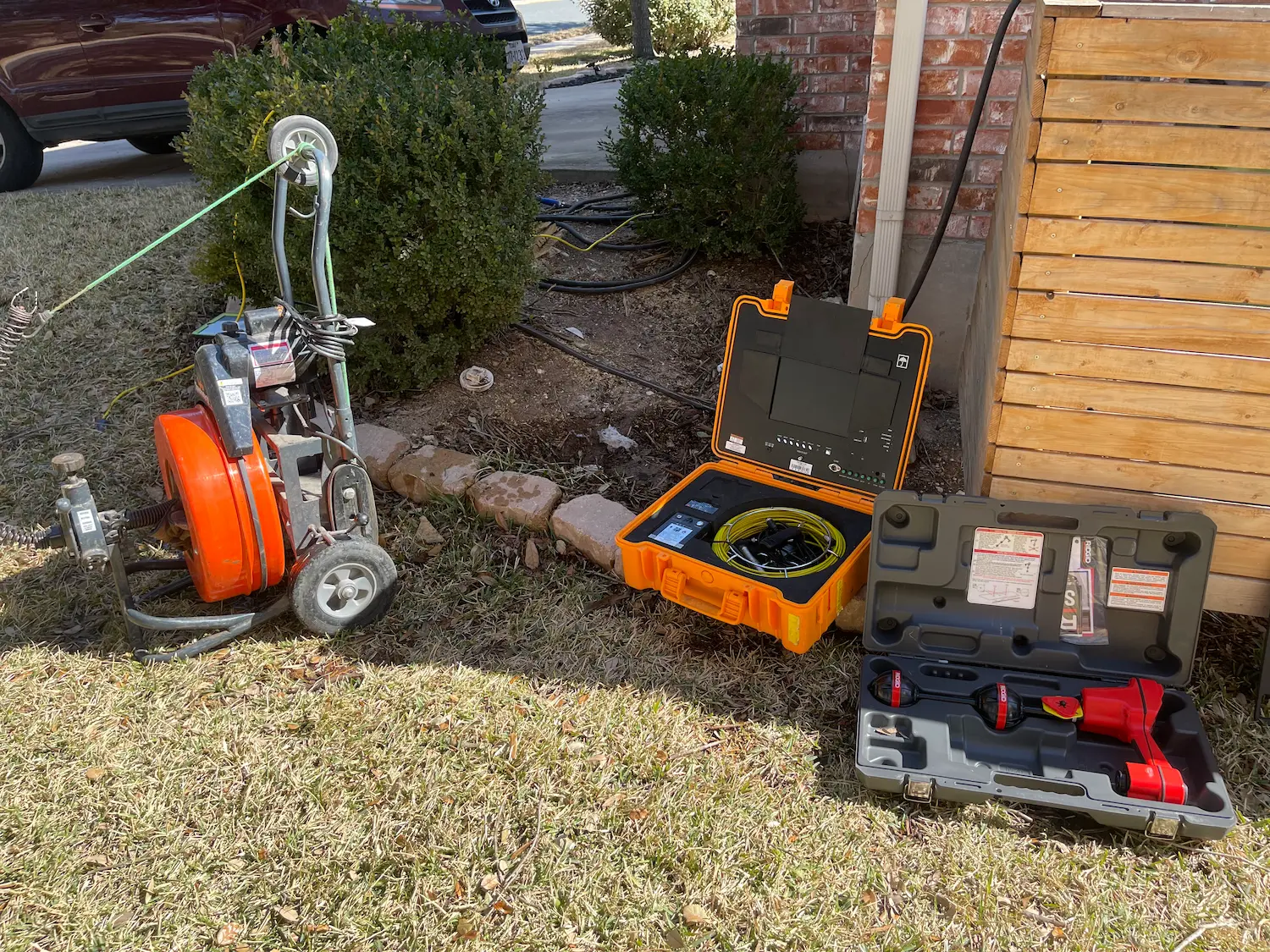
A sewer camera inspection uses a waterproof, self-leveling camera on a flexible push-rod to record video of the inside of your sewer line from the cleanout out to the city tap. It is the only diagnostic that tells you with certainty what is wrong, where it is, and how bad it is — and it is the right starting point for almost every sewer-related service call.
In Round Rock, expect to pay $250-450 for a standalone camera inspection. Most reputable plumbers credit that fee toward any repair work if you proceed.
Why a Camera Beats Guessing
A sewer line is buried 3-6 feet deep, runs 30-80 feet across most residential lots, and is invisible. Without a camera, every sewer-line decision is a guess based on symptoms. The symptoms overlap:
- Backing up could be roots, grease, a foreign object, a belly, or a collapse
- A soggy yard could be a sewer leak, an irrigation leak, or just clay drainage
- A gurgling toilet could be a vent issue or a partial main blockage
Snaking blindly into a damaged pipe can make things worse. Hydro jetting an unsound line can blow weak sections. Replacing a line that just needs a spot repair wastes thousands.
How a Camera Inspection Works
A typical residential inspection takes 30-60 minutes:
- We access the line through the exterior cleanout (or install a temporary access if no cleanout exists)
- The camera is pushed down the line, lit by a bright LED ring, with the operator watching live video
- The push-rod has measurement markings — we can record exactly how far from the cleanout any feature is
- A radio transmitter in the camera head lets us locate its position above ground with a handheld receiver, so we can mark on your yard where a problem is
- We save the video for you and walk through it on-site
You see everything we see. There is no mystery and no upsell pressure.
What the Footage Tells Us
A skilled operator reads a sewer camera the way a doctor reads an X-ray. We are looking for:
Roots — fibrous masses entering at joints. We can see how many entry points, how big the root mass is, and whether the pipe wall is still sound.
Cracks — visible breaks in the pipe wall, often at the 12 or 6 o'clock position. Stress cracks from soil movement are common in Round Rock clay soil.
Offsets — where one section of pipe has shifted relative to the next. Small offsets catch debris. Large offsets are points of imminent failure.
Bellies — low spots where waste pools because the pipe sags. Bellies do not heal — they need regrading.
Scale and grease — calcium deposits from hard water, grease buildup, biofilm. Tells us whether jetting is needed.
Foreign objects — wipes, toys, broken pipe fragments, gravel from a previous repair.
Pipe material and age — clay tile, cast iron, ABS, PVC, Orangeburg. Material drives the repair recommendation.
Connection to the city tap — we can usually see all the way to where your line meets the municipal main.
When You Need a Camera Inspection
Before any major sewer work. No reputable plumber should quote a repair without one.
Buying a home. A pre-purchase sewer inspection is one of the highest-ROI tests in a real estate transaction. Cost: $250-450. Avoided cost if it catches a bad line: $5,000-15,000+. Often missed by general home inspectors.
Selling a home. A pre-list sewer inspection lets you fix anything cheap before negotiation and confirm the line is clean for the buyer.
Older home (25+ years) without a known camera history. Worth doing once just to know what you have.
Repeated main line clogs. Three clogs in 24 months means the camera tells us why.
After major plumbing work. Verifying the work is correct.
Lush green strip or sinking spot in the yard along the sewer route. A camera tells you if it is a sewer leak.
What the Camera CANNOT Show
- A leak from a tiny crack when the line is empty (no water to leak out yet)
- Soil condition outside the pipe
- Whether a connection to the city main is in good shape (we can usually see to it but not into it)
- Conditions in lateral branch lines we did not enter
These limitations are why we sometimes recommend additional diagnostics like electronic leak detection for slow leaks or pressure testing for verifying line integrity.
What the Inspection Report Looks Like
We provide:
- Recorded video of the full inspection
- Still images of any defects we found
- Distance from the cleanout for each defect (in feet)
- A written summary of what we saw
- A clear recommendation: monitor, maintenance, repair, or replace
- A written quote if work is needed
You own the footage. Keep it for your records — it is useful for future home inspections, insurance claims, and tracking line health over time.
Cost Components
A $250-450 camera inspection in Round Rock typically includes:
- Trip, setup, and access through your exterior cleanout
- 30-60 minutes of camera time
- Footage delivery
- Written summary and recommendations
- Verbal walkthrough on-site
Add-ons:
- Above-ground locating ($75-150)
- Cleanout installation if none exists ($600-1,800)
- Additional branch line inspections beyond the main ($150-275 each)
Service Area
Camera inspections available throughout Round Rock, Cedar Park, Pflugerville, Georgetown, Hutto, and Leander.
Related Articles
Need Professional Plumbing Help?
Our licensed plumbers are ready to help with any plumbing issue. Contact us today for fast, reliable service.
Call (512) 598-4241