
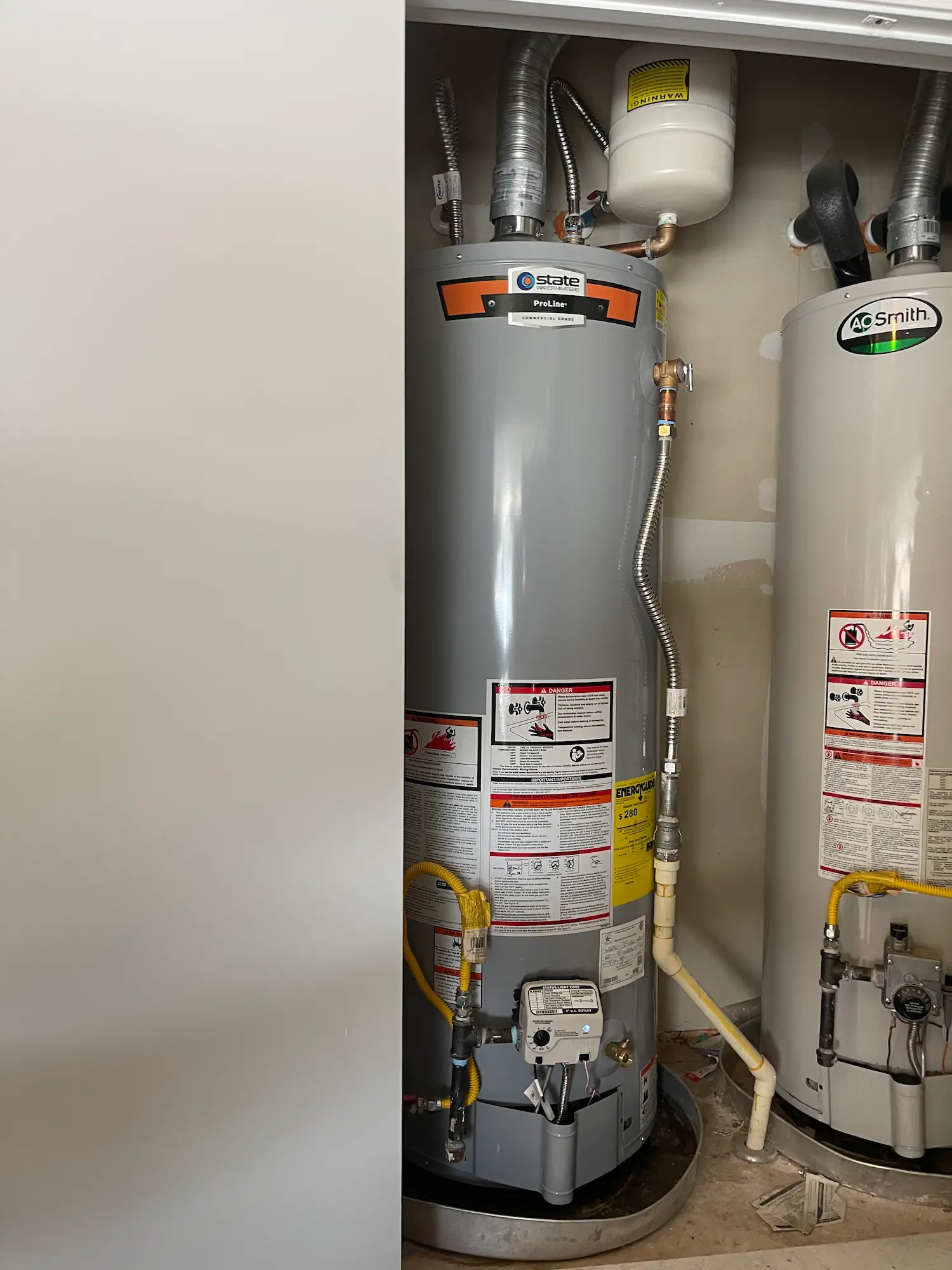
Tankless water heaters cost 2-3 times more upfront than traditional tank units but last roughly twice as long and use 24-34% less energy according to the U.S. Department of Energy. For most Round Rock homes, tankless wins on lifetime cost. For homes with very high simultaneous demand (4+ baths in use at once) or short remaining ownership horizons, traditional still makes sense.
This guide compares the two technologies head-to-head on the factors that actually matter when you are choosing.
Quick Comparison Table
| Factor | Traditional Tank | Tankless |
|---|---|---|
| Upfront installed cost (Round Rock) | $1,000-2,500 | $2,500-5,500 |
| Lifespan | 8-12 years | 15-20+ years |
| Energy efficiency vs. baseline tank | baseline | 24-34% more efficient |
| Hot water capacity | Limited by tank size (40-80 gal) | Unlimited continuous, limited by GPM |
| Simultaneous heavy use | Excellent up to tank size | Limited by unit GPM rating |
| Recovery time | 30-60 min after depletion | Instant |
| Space required | 24" diameter cylinder, 5-6 ft tall | Wall-mounted, suitcase-sized |
| Maintenance | Annual flush recommended | Annual descale required in Round Rock |
| Best for | Larger households, short ownership horizon | Most households, longer ownership |
How They Work
Tank water heaters heat 40-80 gallons of water continuously and store it at temperature, ready to use. When you draw hot water, the tank refills with cold water that the heating element warms back up over the next 30-60 minutes. The downside: 24/7 standby energy loss as the tank loses heat to the surrounding air.
Tankless water heaters heat water on demand. Cold water flows through a heat exchanger that is rapidly heated by a gas burner or electric element only when a hot-water fixture is opened. No tank, no standby loss, no waiting for refill.
Cost Over Time
Here is what the math looks like for a typical Round Rock home over 20 years:
Traditional tank scenario:
- $1,800 install today
- $1,800 install at year 10 (replacement)
- Energy: ~$280/year × 20 = $5,600
- Total: $9,200
Tankless scenario:
- $4,200 install today
- No replacement needed in 20 years
- Energy: ~$200/year × 20 = $4,000
- Annual descaling: $200 × 20 = $4,000
- Total: $12,200
Wait — tankless looks more expensive? That math assumes hard-water descaling every year, which is correct for Round Rock. Skip the descaling and tankless lifespan drops to 8-10 years, defeating the longevity advantage. Read more in our water heater maintenance guide.
If you install a water softener, descaling drops to every 3-5 years and tankless comes out clearly cheaper over 20 years.
When Traditional Tank Is the Right Choice
- Short ownership horizon (selling within 5-7 years). You will not realize the longevity payback.
- Very high simultaneous demand that exceeds the GPM rating of a single tankless unit (some homes need parallel tankless or a much larger tank).
- All-electric house with limited service panel capacity — high-output tankless units need 120 amps of dedicated 240V service.
- Low budget today with willingness to spend more on energy over time.
When Tankless Is the Right Choice
- Long ownership horizon (10+ years). The lifespan and energy savings compound.
- Average household water use (1-3 people using 2-3 fixtures concurrently).
- You have a water softener or plan to install one — descaling burden drops dramatically.
- You want endless hot water — long showers, large tubs filled in one go.
- You need the floor space back — basement, garage, or closet utility area.
What Round Rock Specifically Changes
Hard water. Round Rock municipal water is 15-25 grains per gallon. Tankless heat exchangers scale faster than tank elements because the water is heated more intensely. Without softening and without descaling, a tankless unit in Round Rock can fail in 6-8 years.
Gas availability. Most Round Rock subdivisions built after the mid-1990s have natural gas service. Tankless gas units are roughly 30% more efficient than tankless electric. If you have gas, use it.
Freeze risk. Tankless units installed in unconditioned spaces (garages, exterior walls) need freeze protection. A few hours of below-freezing temperatures can crack the heat exchanger. Most code-compliant installs include freeze protection now, but verify.
Local labor. Tankless installation requires expertise that not every plumber has — sizing, gas line upgrades, venting, descale setup. We do these installations daily and pull all permits.
Sizing: GPM and Temperature Rise
Tankless capacity is measured in gallons per minute (GPM) at a specified temperature rise (the difference between incoming cold water and desired hot water temperature). In Round Rock:
- Incoming groundwater temperature averages 70-75°F
- Desired hot water at fixtures: 120°F
- Temperature rise needed: ~50°F
At a 50°F rise, a typical mid-range tankless delivers 5-7 GPM. That covers:
- A shower (1.8-2.5 GPM) and the kitchen sink (1.5-2 GPM) at once: yes
- Two showers running at the same time: yes for higher-capacity units
- Two showers + dishwasher + laundry hot: usually no — need a higher-end unit or two tankless in parallel
Installation Considerations
Tank: Almost always a like-for-like swap. Same gas line, same vent, same water connections. Half a day of labor.
Tankless: Often needs:
- Gas line upsize (3/4" is the minimum for most tankless; old systems may have 1/2")
- New stainless steel vent (Category III or IV)
- Dedicated electrical circuit for ignition + controls
- Condensate drain (for condensing units)
- Wall mounting and bracket
Full tankless install is typically 1-2 days. We handle gas line work as part of the project.
Hybrid Heat Pump Water Heaters
A third option exists: hybrid heat pump water heaters. They look like tanks but use heat-pump technology to be 3-4x more efficient than electric resistance tanks. Best for all-electric homes with conditioned utility spaces. Pros and cons are a topic for another article — ask us if you want to evaluate this option.
Our Recommendation
For most Round Rock homes, our default recommendation is: gas tankless with a whole-home water softener. The combination gives you endless hot water, lowest lifetime cost, and minimal maintenance burden. We design the system, install it, pull permits, and warranty the work.
If your budget or service panel does not support that, gas tank is the next-best choice. Electric tank is the budget floor.
Service Area
Tankless and traditional installs throughout Round Rock, Cedar Park, Pflugerville, Georgetown, and Hutto.
Related Articles
Need Professional Plumbing Help?
Our licensed plumbers are ready to help with any plumbing issue. Contact us today for fast, reliable service.
Call (512) 598-4241