
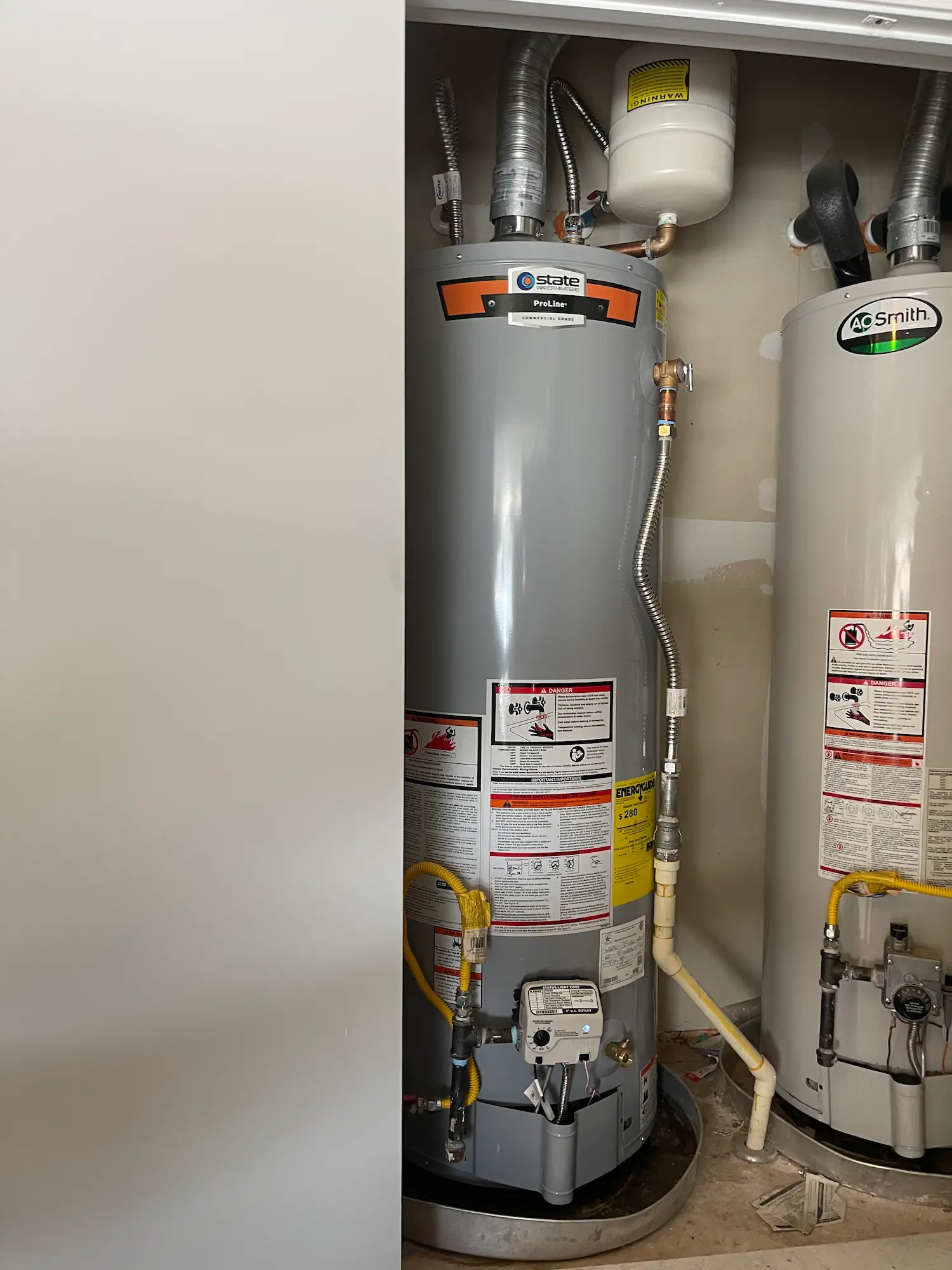
A water heater in Round Rock can last 50% longer than the national average with five simple maintenance habits: annual tank flush, anode rod check every 3-5 years, T&P valve test annually, sediment buildup monitoring, and (for tankless) annual descaling. Each of these is fast, mostly cheap, and adds years to the life of a unit that costs $1,000-5,500 to replace.
This guide is what we walk through with new customers on their first service call.
Why Maintenance Matters More in Round Rock
Round Rock municipal water is 15-25 grains per gallon — classified as "very hard" by the U.S. Geological Survey. The dissolved calcium and magnesium minerals plate onto every surface they touch — heat exchanger fins, tank bottoms, dip tubes, heating elements.
Without maintenance, a Round Rock water heater can lose 30-40% of its rated lifespan. With maintenance, you can hit or exceed the manufacturer's projected life.
Task 1: Annual Tank Flush (Tank Units Only)
What it does: removes the sediment layer that accumulates at the bottom of the tank.
How often: once a year. Twice a year if you do not have a water softener.
How to do it yourself:
- Turn off the gas (set to "vacation" or "pilot") or kill the electric breaker
- Connect a hose to the drain valve at the bottom of the tank
- Open the T&P valve at the top to break vacuum
- Open the drain valve and run 3-5 gallons through into a bucket or floor drain
- Watch the water — when it runs clear, close the drain valve
- Close the T&P valve, refill the tank, restore power/gas
If the water never runs clear, or if you see large sediment chunks, call us — full sediment removal may need a power-flush.
Time: 15-20 minutes. Risk to homeowner: low.
Task 2: Anode Rod Check (Tank Units Only)
What it does: the anode rod (a magnesium or aluminum bar inside the tank) corrodes preferentially to protect the tank from rust. Once consumed, the tank starts to corrode and fail.
How often: check at year 3, replace at year 4-5 in Round Rock.
This is the single highest-ROI maintenance task. A $35-65 anode rod replaced on schedule can extend tank life by 5+ years. It is also the most commonly skipped task.
The check requires:
- Cold water shutoff
- Drain a few gallons from the tank
- Remove the anode hex head with a 1-1/16" socket and breaker bar (often needs an impact wrench because of corrosion)
- Pull the anode out and inspect
If less than 6 inches of solid material remains on a 44-inch rod, replace it. If it is heavily pitted or coated with sediment, replace it.
This is a service we recommend most homeowners outsource — the breaker-bar torque required to back out a corroded hex head is significant and the work is in a tight space.
Task 3: TPR (Temperature and Pressure Relief) Valve Test
What it does: the TPR valve is a safety relief that opens if the tank gets too hot or too pressurized. Sediment and mineral buildup can plug it over time, defeating its safety purpose.
How often: annually.
How to do it:
- Locate the TPR valve (usually on the side of the tank near the top, with a discharge tube pointing down)
- Place a bucket under the discharge tube
- Lift the lever briefly — water should rush out
- Release the lever — water should stop completely
- If water keeps dripping after, or if no water came out, the valve needs replacement
Time: 5 minutes. Risk: low — but if the valve does not reseal, you will need to replace it before water damage occurs.
Task 4: Visual Inspection
Once a year, walk around your water heater and look for:
- Rust spots on the tank exterior
- Moisture or staining on the floor around the base
- Corrosion at fittings, supply lines, or shutoff valves
- Soot near the gas burner (gas units)
- Discoloration around the vent collar
Any of these is reason to schedule a service call before the issue compounds.
Task 5: Tankless Annual Descale
What it does: removes calcium scale from inside the heat exchanger before it causes performance loss or unit failure.
How often: annually in Round Rock without a softener. Every 2-3 years with a softener.
What it involves:
- Isolate the unit with the service valves (good installs include these)
- Connect a pump to the cold-side service valve
- Circulate undiluted white vinegar or commercial descaling solution through the heat exchanger for 45-60 minutes
- Flush with clean water
- Restore service
This is a routine call for us — typically $200-275. Some advanced homeowners do it themselves with a $100 descaling kit, but it requires confidence working with the unit.
What NOT to Do
- Do not crank the temperature up to "make the hot water last longer." Higher temps accelerate scaling and shorten life. 120°F is the sweet spot.
- Do not ignore drips or pinhole leaks. A pinhole becomes a flood. The earlier you catch it, the cheaper the fix.
- Do not skip flushing because the tank "seems fine." Sediment damage is internal and progressive — by the time you can see the symptoms, the tank is already shortened.
- Do not store flammable materials near a gas water heater. Clearance requirements exist for safety reasons.
- Do not insulate around the burner intake or vent on a gas unit. Restricting airflow causes incomplete combustion.
When to Call a Pro
- The drain valve will not close after a flush (very common — they fail)
- The anode rod cannot be removed by hand-tool effort
- The TPR valve does not reseal after testing
- You see any signs of leaking
- The pilot light will not stay lit
- Any maintenance task you are uncomfortable performing
We perform maintenance calls year-round and offer annual maintenance contracts that include flushing, anode checking, and a full inspection for one flat price.
Service Area
Maintenance and repair throughout Round Rock, Cedar Park, Pflugerville, Georgetown, and Hutto. Schedule maintenance any time.
Related Articles
Need Professional Plumbing Help?
Our licensed plumbers are ready to help with any plumbing issue. Contact us today for fast, reliable service.
Call (512) 598-4241