
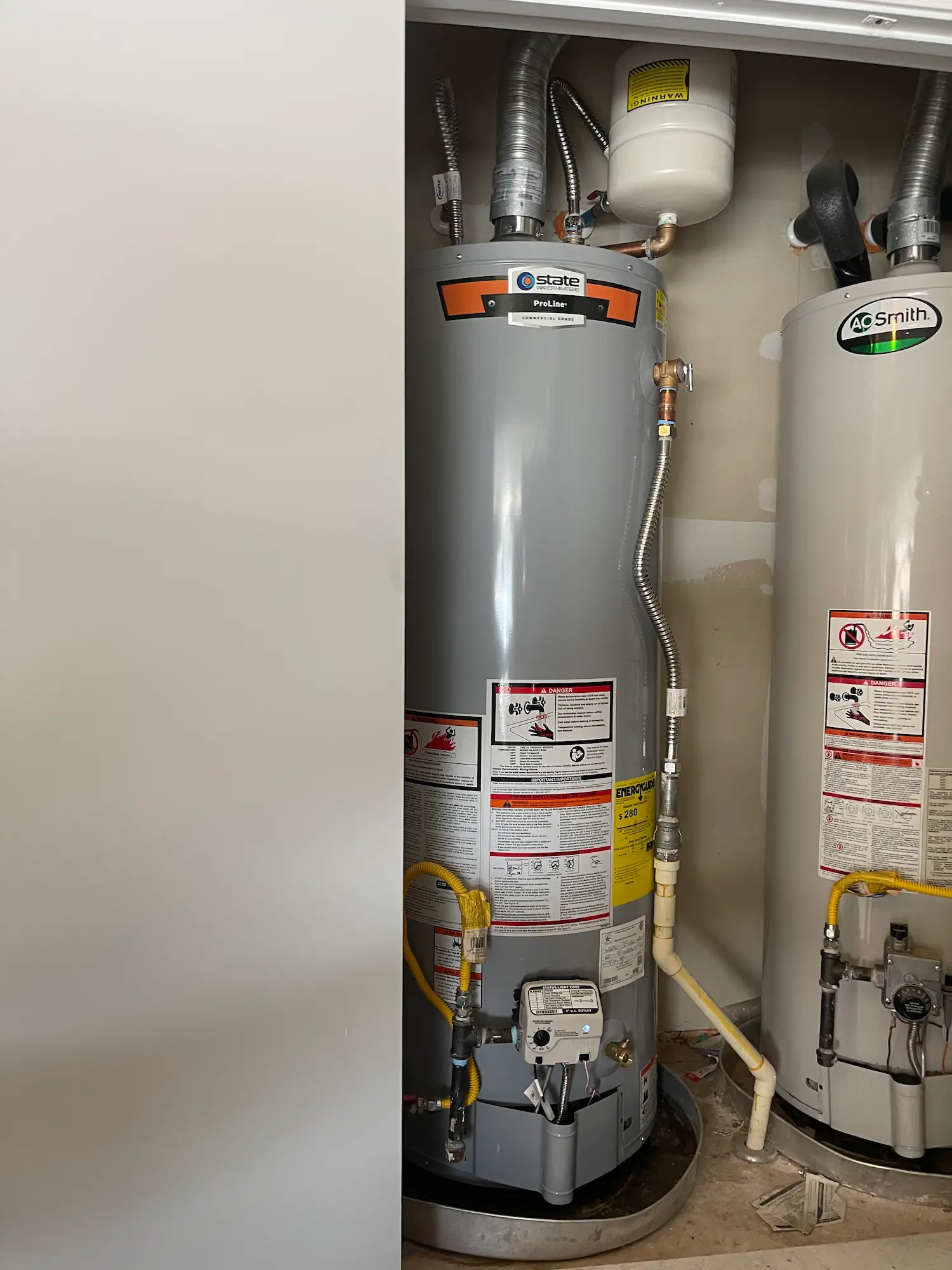
A traditional tank water heater lasts 8-12 years on average. A tankless water heater lasts 15-20+ years with proper maintenance. A heat pump (hybrid) tank lasts 10-15 years. These are national averages — Round Rock's hard water cuts those numbers by 20-30% if no preventive maintenance is done, and water softening + annual maintenance extends them well past the upper range.
Average Lifespan by Type
| Type | National average | Round Rock without softening | Round Rock with softener + maintenance |
|---|---|---|---|
| Gas tank | 8-12 years | 6-10 years | 12-15 years |
| Electric tank | 10-15 years | 8-12 years | 14-18 years |
| Tankless gas | 15-20+ years | 8-12 years | 20+ years |
| Tankless electric | 15-20 years | 10-14 years | 18-22 years |
| Heat pump (hybrid) | 10-15 years | 9-13 years | 14-17 years |
The gap between "with softener" and "without softener" is bigger than most homeowners realize, especially for tankless units.
What Actually Wears Out
Tank water heaters fail because of:
- Sediment buildup — Round Rock hard water deposits calcium and magnesium on the bottom of the tank. The sediment layer insulates the heating element from the water, making the heater work longer and hotter to deliver the same hot water. Eventually the element burns out, or the tank wall corrodes from beneath the sediment.
- Anode rod depletion — every tank has a sacrificial anode rod (usually magnesium or aluminum) that corrodes preferentially to protect the tank itself. Once the anode is consumed (typically 3-5 years in hard water), the tank starts to corrode.
- Heating element failure — electric models. Elements scale up and burn out, especially without periodic flushing.
- Burner or gas valve failure — gas models. Less common but does happen.
- Tank leak from corrosion — the failure mode. Once a tank leaks, replacement is the only option. You cannot patch a water heater tank.
Tankless water heaters fail because of:
- Heat exchanger scaling — the dominant Round Rock failure mode. Scale builds inside the narrow waterways of the heat exchanger and eventually causes overheating, flow reduction, or cracking.
- Flame sensor and ignitor failure — wear items, typically replaceable in the field.
- Combustion chamber corrosion — venting that lets in moisture or backdraft can corrode the burner area. Code-compliant installs avoid this.
- Control board failure — electronics fail eventually. Usually replaceable.
The key difference: tank units fail catastrophically (leak = replace). Tankless units fail in pieces that can often be repaired.
Signs Yours Is Nearing the End
For tank units:
- Age past 10 years
- Rust-colored hot water from the tap
- Rumbling, popping, or banging sounds during heat-up
- Less hot water than you used to get
- Visible rust or moisture around the base
- Pilot light keeps going out (gas)
For tankless units:
- Age past 12 years without descaling history
- Reduced GPM at the same fixtures
- Frequent error codes
- Banging or kettling sounds during operation
- Hot water comes and goes during a single shower
See our companion post on warning signs you need water heater replacement for details on each.
What Affects Lifespan in Round Rock
Water hardness — the biggest factor. 15-25 GPG in Round Rock municipal water. Every additional degree of hardness shortens water heater life. A water softener is the single most impactful upgrade.
Tank temperature setting. Higher temperatures (140°F+) accelerate scaling and corrosion. 120°F is the sweet spot for safety, efficiency, and longevity.
Maintenance habits. Annual flush for tank units. Annual descale for tankless. Anode rod check every 3-5 years. See the full water heater maintenance guide.
Installation quality. Right-sized unit, proper venting, code-compliant gas line, expansion tank where required, sediment trap on the gas line. Cheap installs fail early.
Water pressure. Pressure above 80 PSI stresses the tank wall and shortens life. A PRV (pressure-reducing valve) keeps house pressure in the safe range.
Usage volume. Heavy daily use depletes anode rods faster and cycles the heating elements more.
How to Extend the Life of Your Water Heater
For tank units:
- Flush the tank once a year (drain 2-3 gallons until it runs clear)
- Check the anode rod at year 3, replace at year 5 (massive lifespan extension)
- Install a water softener
- Verify pressure is under 80 PSI (install PRV if needed)
- Set thermostat to 120°F
- Test the TPR valve once a year
For tankless units:
- Descale annually (or every 3 years if softened)
- Clean the inlet water filter every 6 months
- Inspect venting annually for soot, moisture, or corrosion
- Have a professional service it every 18-24 months
When to Replace vs. Repair
Replace if:
- The tank is leaking (always — no exceptions)
- The unit is past 12 years and needs major repair (control board, gas valve)
- The unit cannot keep up with current household demand
Repair if:
- A specific component has failed and the unit is otherwise sound
- The unit is under 8 years old
- Repair cost is less than 50% of replacement cost
We will give you a straight assessment on a service call — we do not push replacements when repair is the right call.
Our Installation and Service
Tank and tankless installation, repair, and maintenance throughout Round Rock, Cedar Park, Pflugerville, Georgetown, and Hutto. Schedule service or get a free replacement quote by phone.
Related Articles
Need Professional Plumbing Help?
Our licensed plumbers are ready to help with any plumbing issue. Contact us today for fast, reliable service.
Call (512) 598-4241