
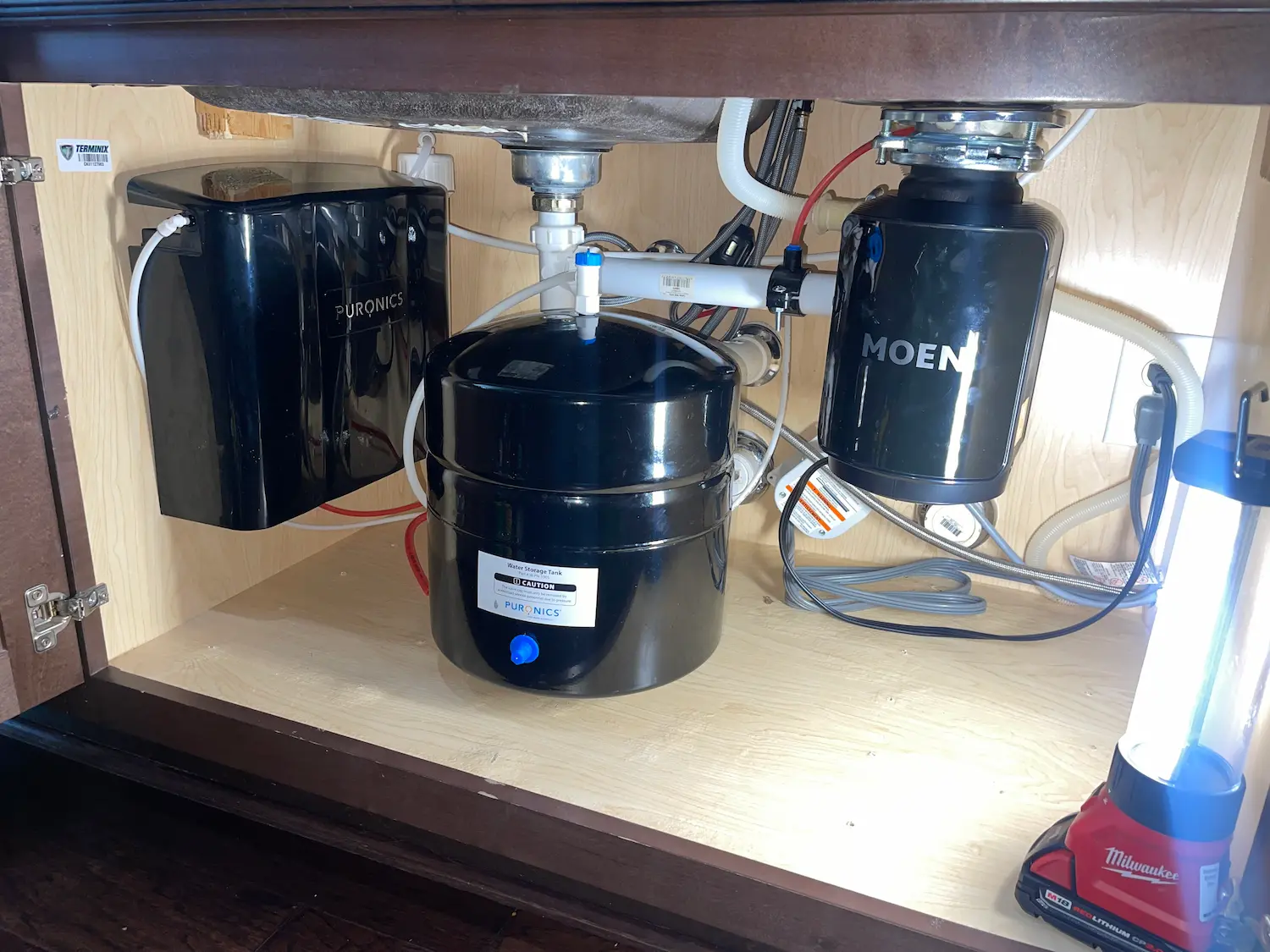
Round Rock municipal water is consistently 15-25 grains per gallon, classified as "very hard" by the U.S. Geological Survey. Every Round Rock plumber sees the same evidence weekly: scaled-up water heaters, white residue on fixtures, soap scum, and shortened appliance life. A properly sized water softener is the highest-ROI plumbing investment most Round Rock homeowners can make.
This buying guide walks through softener types, sizing, what a good installation includes, and approximate costs.
What Hard Water Actually Does
Hardness comes from dissolved calcium and magnesium minerals. They cause:
- Scale buildup in water heaters, dishwashers, washing machines, ice makers, coffee makers
- Reduced appliance lifespan (30-50% shorter for water heaters specifically)
- Soap scum on bathtubs, glass shower doors, sinks
- Spotted glasses and dishes in dishwasher
- Stiff laundry that requires more detergent
- Lifeless hair and dry skin in some people
- Pinhole leaks in copper pipes over decades of mineral contact
See our companion post on hard water problems and solutions for more.
Three Softener Technologies Explained
Ion-Exchange (Salt-Based) — The Gold Standard
How it works: water passes through resin beads coated with sodium ions. The calcium and magnesium in hard water swap places with the sodium and stay on the beads. Periodic "regeneration" flushes the resin with brine to restore it.
Pros:
- Most effective at actually removing hardness
- Mature, well-understood technology
- 15-25 year lifespan with maintenance
- Reasonable salt cost ($40-80/year)
Cons:
- Adds small amount of sodium to water (problematic for very low-sodium diets — install a separate RO drinking water tap)
- Requires periodic salt refills
- Discharges brine to drain during regeneration
- Some HOAs and municipalities restrict softener discharge
This is what we recommend for almost every Round Rock home.
Salt-Free "Conditioners" — Marketing-Heavy Category
How it works: various mechanisms (template-assisted crystallization, magnetic, etc.) that supposedly change the calcium structure so it does not deposit as scale, without actually removing minerals.
Pros:
- No salt, no brine discharge
- No regeneration cycle
- Lower maintenance
Cons:
- Independent testing shows mixed results — works in some installations, does nothing in others
- Marketing often overstates effectiveness
- Does not provide actual soft water (no "slippery" feel, no soap scum reduction)
- Does not protect against scaling in static water (water heater tank bottoms still scale)
We rarely recommend salt-free conditioners for Round Rock hardness. Some homeowners install them where ion-exchange is restricted (specific HOAs).
Reverse Osmosis — For Drinking Water Only
How it works: water is forced through a semi-permeable membrane that removes most dissolved solids including minerals.
Pros:
- Highly effective on dissolved solids
- Improves taste of municipal water
- Removes lead, fluoride, chlorine, many other concerns
Cons:
- Wastes 2-4 gallons for every 1 gallon of purified water
- Slow flow rate (typical RO produces 1-2 gallons per hour)
- Cannot be used for whole-home softening — only point-of-use (under-sink for drinking water)
- Removes beneficial minerals along with hardness
Use RO for drinking water under a kitchen sink. Use ion-exchange softening for whole-home.
Sizing for Round Rock Hardness
Softener capacity is measured in "grain capacity" — how many grains of hardness it can remove between regeneration cycles. The right size depends on:
- Number of people in the home
- Daily water use (gallons per person)
- Hardness of incoming water (15-25 GPG in Round Rock)
A rough sizing formula:
(People) × (75 gallons/day average) × (Hardness GPG) × (Days between regenerations)
For a family of 4 in Round Rock with 20 GPG water on a 6-day cycle:
4 × 75 × 20 × 6 = 36,000 grain capacity
Round up to the next standard size (typically 48,000 grain). Most family-of-3-4 Round Rock homes are well served by 40,000-48,000 grain softeners.
What a Good Installation Includes
A complete softener installation:
- The softener unit and brine tank
- Connection to the cold water supply BEFORE the water heater (to soften both hot and cold)
- Bypass valve for emergencies and maintenance
- Drain connection for regeneration discharge (per code)
- Drip pan with leak protection (highly recommended)
- Initial salt loading
- Programmed regeneration schedule based on your usage
- Hardness testing before and after to confirm performance
- Warranty registration
Expected Cost in Round Rock
| Softener type | Equipment | Installed cost |
|---|---|---|
| Entry-level ion-exchange (32,000-40,000 grain) | $600-1,000 | $1,500-2,500 |
| Mid-range ion-exchange (48,000-60,000 grain) | $1,000-1,800 | $2,000-3,500 |
| High-efficiency dual-tank | $1,800-3,500 | $3,500-5,500 |
| Salt-free conditioner | $1,200-2,500 | $2,200-4,000 |
| Whole-home with carbon pre-filter | $1,800-3,500 | $3,000-5,500 |
Installation cost variation comes from plumbing access, drain access for the regeneration discharge, and whether new shutoff valves and bypass plumbing are needed.
What Adds Value vs. What Adds Cost
Worth paying for:
- Quality resin (high cross-link percentage — lasts longer)
- Demand-initiated regeneration (regenerates based on actual water use, not just a calendar)
- Larger capacity for fewer regenerations (saves salt and water)
- Reliable brand with local service support
Probably skip:
- "Smart" Wi-Fi features that you will never use
- Excessive over-sizing
- Add-on "magnetic" or "vortex" devices (marketing)
Maintenance
Once installed:
- Add salt when the tank is below half-full (typical 1-2 bags per month for a family of 4)
- Annual hardness check to confirm performance
- Resin replacement at year 12-15 in Round Rock
- Quick visual inspection monthly for leaks or salt bridging
Insurance and Code Considerations
- Most Texas insurance carriers view a whole-home softener as a positive (extends plumbing life)
- Round Rock and Williamson County require permits for water treatment equipment in some scenarios
- Some HOAs restrict softener discharge type or location
- Texas requires that softener discharge go to a code-approved drain
We handle permitting as part of installation.
Service
Water softener installation throughout Round Rock, Cedar Park, Pflugerville, Georgetown, and Hutto. Free hardness testing and sizing consultation.
Related Articles
Need Professional Plumbing Help?
Our licensed plumbers are ready to help with any plumbing issue. Contact us today for fast, reliable service.
Call (512) 598-4241