
A slab leak is a leak in a water line that runs under the concrete foundation slab of your home. They are common in Round Rock for two reasons: most homes here are built slab-on-grade (no basement), and our Blackland clay soil swells and shrinks dramatically with moisture changes, stressing the copper supply lines buried in the slab.
We see slab leaks most often in 25-35 year old Round Rock neighborhoods — Forest Creek, Cat Hollow, Stone Canyon, Behrens Ranch, and Vista Oaks all have housing stock at the prime age for under-slab copper failures.
The five most reliable warning signs are below. Catching a slab leak in the first week saves thousands compared to letting it run for months.
Sign 1: Warm or Hot Spots on the Floor
Hot water lines run pressurized at ~120°F. When one leaks under the slab, the surrounding concrete and flooring warms. Walk your home barefoot — you may find a warm spot you have never noticed before, often in a hallway, bathroom, or kitchen.
This sign points specifically to a hot-side slab leak. Cold-side leaks do not produce thermal signatures.
Sign 2: Sound of Running Water With Everything Off
Stand in the quietest part of your house with all fixtures off, the dishwasher and washing machine idle, the ice maker not cycling. Listen.
If you hear a faint hiss or running water sound coming from under the floor, you may have a slab leak. The sound is often most audible at night.
Sign 3: Sudden, Unexplained Spike in Water Bill
A slab leak releases water continuously under the slab. Even a small leak can waste 10,000-30,000 gallons per month — visible as a 2-5x jump in your water bill with no change in usage.
Compare your last 3 bills to the same months a year prior. A sudden upward step is the most quantitative slab leak indicator.
Sign 4: Loss of Water Pressure
A leak under the slab reduces pressure at every fixture downstream of it. If your shower has lost noticeable pressure or your kitchen sink runs slower than it used to, with no obvious cause, suspect a leak.
This sign overlaps with other causes (clogged aerators, failing PRV, sediment in supply lines) so it is rarely diagnostic on its own.
Sign 5: Mildew Smell, Mold, or Foundation Cracks
Late-stage slab leaks have already saturated the soil under the slab. Water wicks up through the concrete, soaks into baseboards and lower drywall, and creates a musty smell. Persistent mildew under flooring or visible moisture stains low on walls are signals you have had a leak for a while.
In severe cases, sustained moisture causes the clay soil to expand, lifting one part of the slab relative to the rest and cracking interior tile, drywall, or door frames.
Why Round Rock Has More Slab Leaks Than Average
Three factors compound:
Soil. Blackland clay swells when wet and shrinks when dry. The seasonal cycle stresses every buried pipe, especially copper that has been in the ground 20+ years.
Copper pipe corrosion. Many homes built in the 1990s-2000s used Type M copper (thinner-walled) under the slab. Combined with hard water inside the pipes and clay soil outside, pinholes are common after 20-25 years.
Foundation movement. Round Rock foundations move seasonally. The same movement that cracks drywall and sticks doors also cracks rigid copper pipe at joints and stress points.
See our companion post on foundation movement and plumbing leaks for the full story.
How We Find a Slab Leak
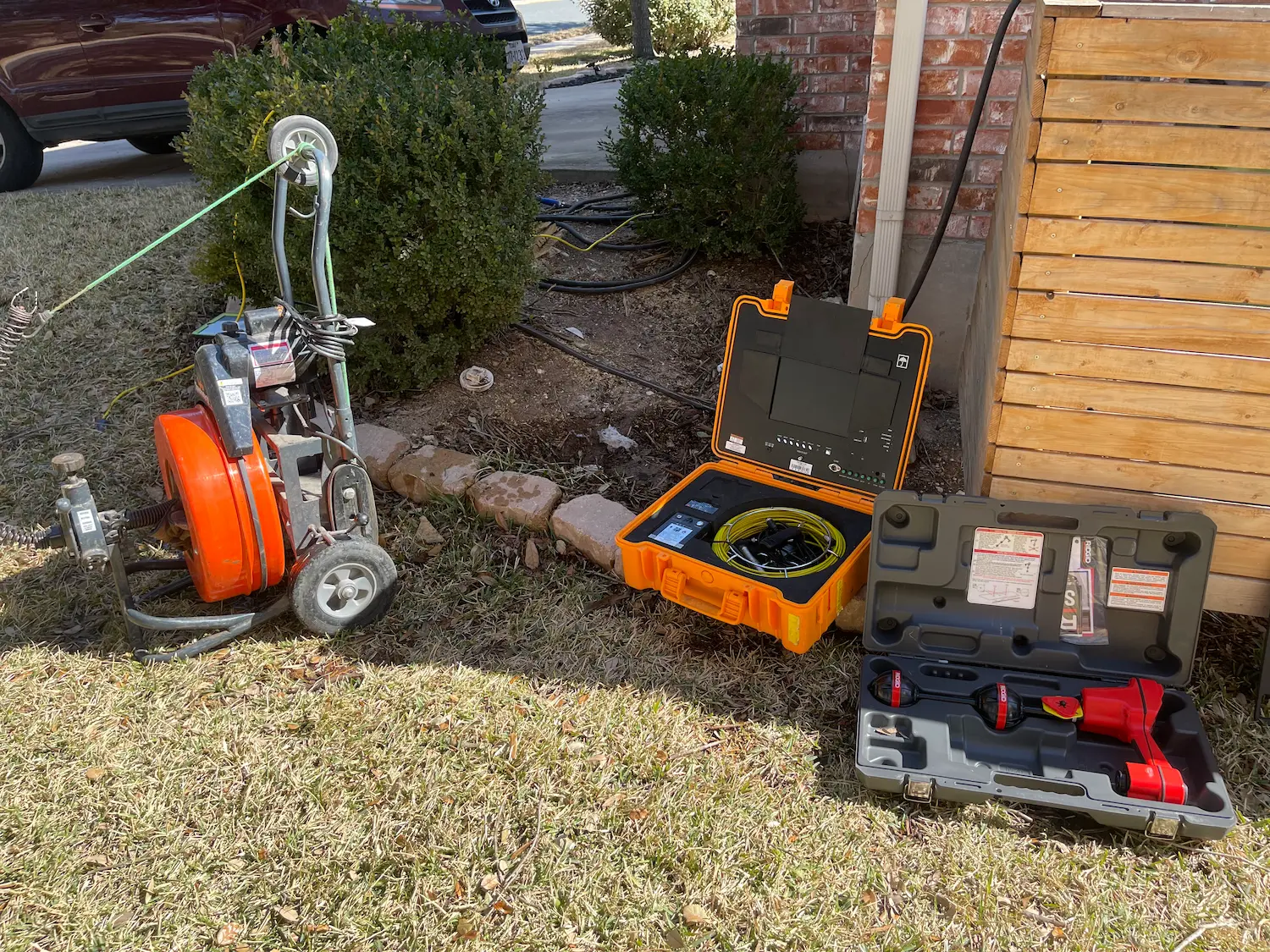
Modern non-destructive leak detection uses several technologies in combination:
- Acoustic correlator — high-sensitivity microphones placed on the floor or accessible plumbing pinpoint the leak sound to within 1-2 feet
- Thermal imaging — infrared camera detects the temperature anomaly from a hot-side leak
- Tracer gas — non-toxic hydrogen-nitrogen mix introduced to the line escapes through the leak and is sniffed at the surface
- Pressure isolation — testing line segments individually to confirm which is leaking
A complete detection workup typically takes 1-3 hours and runs $400-900 in Round Rock. See electronic leak detection explained and our electronic leak detection service.
Slab Leak Repair Options
Once located, three repair paths:
- Spot repair — open the floor over the leak, jackhammer the slab, repair the section, patch. $1,500-4,500. Best for a single leak in an accessible area.
- Reroute — abandon the leaking line in the slab and run a new line through walls and ceilings to bypass it. $1,500-5,000. Best when access through the floor is difficult.
- Whole-home repipe — replace all under-slab supply lines, typically with overhead PEX. $4,000-12,000. Best when the home has had multiple leaks or the pipe is age-end.
See signs you need repiping and cost of whole-home repiping.
Insurance Considerations
Standard Texas homeowners policies typically:
- Cover water damage from a sudden leak (with deductible)
- Do NOT cover the cost of finding and repairing the leak itself
- May cover slab cutting and restoration with the right endorsement
- Often require slab leak documentation within a specific window
If you suspect a slab leak, document everything, photograph the warm spot or moisture, and contact your insurance before any major work. See our deep dive on slab leak insurance claims.
When to Call
If you have any of the five signs above, call sooner rather than later. A confirmed slab leak that is letting water under your foundation costs more every week — both in wasted water and in soil saturation that can affect the foundation itself.
Schedule leak detection or call for same-day assessment.
Service Area
Slab leak detection and repair throughout Round Rock, Cedar Park, Pflugerville, Georgetown, and Hutto.
Related Articles
Need Professional Plumbing Help?
Our licensed plumbers are ready to help with any plumbing issue. Contact us today for fast, reliable service.
Call (512) 598-4241