Low-Flow Fixtures for Commercial Properties

Low-flow fixtures can cut water usage in commercial buildings by 30% to 50%, bringing both cost savings and water conservation benefits. Restroom fixtures in offices alone account for 60% of water use, making them a key focus for upgrades. Modern low-flow options, like faucets, toilets, showerheads, and urinals, are designed for efficiency and durability in high-traffic environments.

Key points:

  • Water Savings: Commercial low-flow toilets use 1.0–1.28 gallons per flush, compared to up to 7 gallons in older models. Faucets reduce flow to 0.35–0.5 GPM.
  • Cost Impact: High water costs in cities like San Francisco ($6.07/m³) make savings more noticeable. Retrofitting can save thousands annually.
  • Maintenance: Commercial fixtures often require specialized upkeep, such as sensor calibration or cartridge replacements.
  • Technology: Touchless faucets, waterless urinals, and efficient showerheads improve hygiene and reduce waste.

Upgrading outdated fixtures is especially relevant for older buildings, which often predate low-flow regulations. For businesses, working with experts ensures proper installation and compliance with local codes, maximizing savings and efficiency. Regular camera inspections can also help identify hidden leaks or blockages before they impact performance.

Commercial vs Residential Low-Flow Fixtures Comparison Chart

Commercial vs Residential Low-Flow Fixtures Comparison Chart

Save Water in Your Restaurant: Install Low-Flow Pre-Rinse Spray Valves

1. Low-Flow Faucets

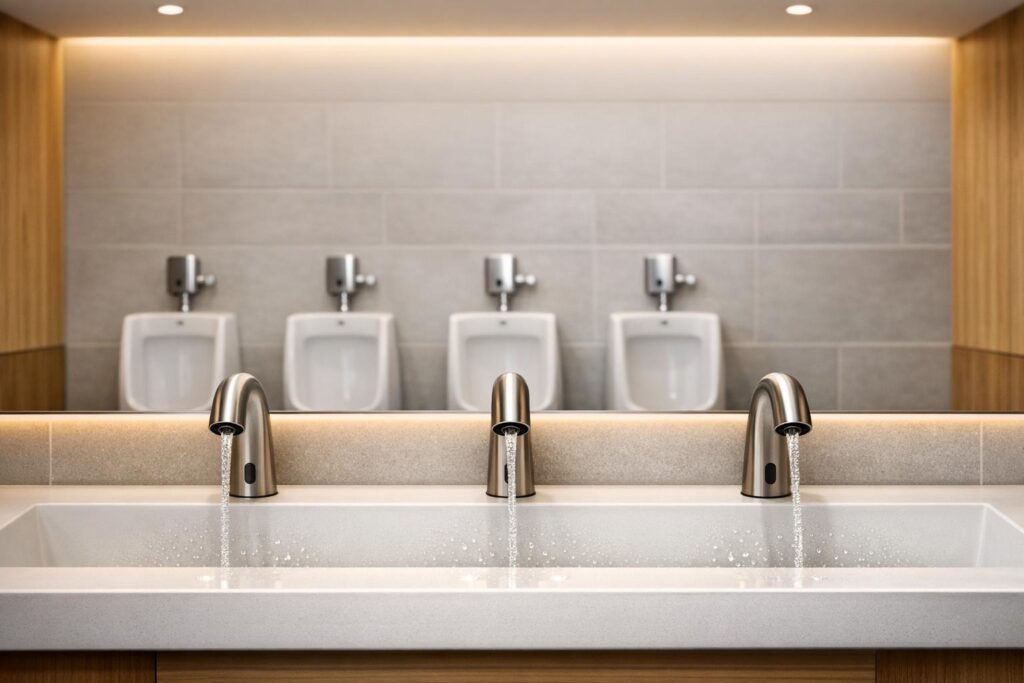
Low-flow faucets are designed to reduce water usage without compromising functionality. In commercial settings, these faucets typically deliver 0.35–0.5 gallons per minute (GPM), while residential models average around 1.5 GPM. The difference is intentional – commercial restrooms prioritize quick, efficient handwashing, while residential faucets often need higher flow rates for tasks like filling pots or rinsing dishes.

Commercial low-flow faucets often come equipped with sensor-activated or metering systems. These touchless designs not only prevent water waste from taps being left on but also reduce bacterial surface contamination by up to 90%. When paired with 0.35 GPM aerators, they can cut water usage by approximately 54% compared to manual faucets. On the other hand, residential faucets rely on manual handles, making water savings heavily dependent on the user’s habits.

Feature Commercial Low-Flow Faucets Residential Low-Flow Faucets
Flow Rate 0.35–0.5 GPM Typically 1.5 GPM
Activation Sensor-activated or metering Manual operation
Durability Vandal-resistant, heavy-duty materials Aesthetic-focused, standard materials
Maintenance Sensor calibration, battery replacement, aerator cleaning Leak repair or cartridge replacement

Maintenance needs differ as well. Commercial faucets demand regular calibration of sensors, battery replacements, and cleaning of aerators. They are built with vandal-resistant finishes, like PVD coatings, to endure heavy use and harsh cleaning chemicals. Residential faucets, by contrast, are simpler to maintain, typically requiring occasional leak repairs or cartridge replacements.

For commercial properties, the return on investment tends to be quicker due to higher water usage. Retrofitting existing faucets with 0.5 GPM aerators can lead to substantial monthly savings – potentially hundreds of dollars. A cost-effective approach is to add vandal-proof aerators to existing fixtures instead of replacing the entire faucet assembly.

If you’re managing a commercial property and need expert installation or maintenance for low-flow faucets, Round Rock Plumbing offers tailored services to enhance water efficiency and ensure long-term reliability.

This commitment to water-saving technology naturally extends to low-flow toilets, which share similar benefits in efficiency and durability.

2. Low-Flow Toilets

Commercial low-flow toilets operate differently from residential models. Instead of the gravity-fed systems found in homes, commercial toilets use tankless flushometer valves connected to pressurized lines. This difference impacts installation, maintenance, and overall performance.

For instance, commercial flushometer systems require a 1-inch supply line and at least 35 psi of water pressure. These requirements often mean upgrading plumbing systems, unlike residential toilets, which use 1/2-inch lines and rely on gravity. This technical variation directly affects both performance and cost efficiency, especially in high-traffic areas.

Water savings are especially noticeable in commercial settings due to frequent use. According to Lovin Saini of Gerber Plumbing Fixtures, while the average household toilet is flushed five times a day, a high-traffic commercial facility might see up to five flushes per hour. To illustrate, a 10-story office building with 1,000 occupants could save nearly 1.2 million gallons of water annually by switching to WaterSense models. That’s a savings of about $10,000 per year, compared to the approximately $20 saved annually by a single residential low-flow toilet.

Feature Commercial Low-Flow Residential Low-Flow
Flush Mechanism Flushometer valve (tankless) Gravity-fed (tank-based)
Supply Line 1-inch diameter 1/2-inch diameter
Flush Volume 1.0–1.28 gallons per flush Up to 1.28 gallons per flush
Mounting Often wall-mounted Typically floor-mounted
Maintenance Specialized parts; professional service DIY-friendly; inexpensive parts
Durability Thicker vitreous china; 10–20 years Standard construction

These design differences are essential for achieving maximum water savings in commercial environments with heavy usage.

Maintenance costs also vary significantly. Residential toilets are relatively simple, with parts like flappers and fill valves that are inexpensive and easy to replace. On the other hand, commercial systems require specialized components and professional servicing. However, they are designed with quick-replacement parts to minimize downtime. Additionally, the EPA mandates a minimum flush volume of 1.0 gallons per flush for commercial toilets to ensure waste can be effectively transported through the long horizontal drainlines found in larger buildings. Facility managers should consult plumbing engineers to ensure their building’s water pressure and drainline systems are compatible with these fixtures. Proactive electronic leak detection can also help identify hidden issues in these complex pressurized systems before upgrades begin.

For tailored installation and maintenance solutions, local professionals like Round Rock Plumbing (https://roundrockplumbing.co) provide expertise in advanced low-flow toilet systems.

3. Low-Flow Showerheads

Commercial showerheads face unique challenges compared to residential ones. In places like hotels, dormitories, and barracks, these fixtures endure almost constant use. They must handle frequent operation, resist wear and tear, and maintain performance under tough conditions, such as aggressive water chemistry or even vandalism. Grace Thompson, an industry expert, points out that showerheads that perform well in showrooms can fail quickly in these demanding environments. This focus on durability aligns with the broader push for efficiency in other low-flow commercial fixtures.

The potential for saving water and energy in these settings is huge. Take the example of the Holiday Inn at San Antonio International Airport. Back in 2007, they retrofitted all 397 guest room bathrooms through the WaterSaver Hotel program. The result? A 35% reduction in water bills, nearly 7 million gallons saved, and the retrofit costs paid off in less than two years. Julia Q. Ortiz, Press Officer at the EPA, highlights how:

buildings with a high fixture count per square foot, such as barracks, dorms, office buildings, and hotels, generally tend to benefit more [from low-flow retrofits].

Modern low-flow showerheads achieve these savings by using aerators or flow restrictors to reduce water flow from pre-1992 levels of 4.5–8.0 gallons per minute (gpm) to 1.5 gpm or less [6, 11]. However, Laurie Gilmer, a mechanical engineer at Facility Engineering Associates, notes:

while ultra-low-flow showerheads yield significant water savings compared to standard models, they don’t always receive high marks from users.

This trade-off is particularly crucial in commercial settings, where guest satisfaction directly affects revenue.

Despite some challenges, such as longer wait times for hot water or potential clogging, low-flow showerheads remain an excellent choice for high-traffic environments. These fixtures not only reduce water usage but also lower energy consumption. Facility managers can tackle potential downsides by insulating hot water pipes and improving recirculation systems [23, 24]. It’s worth noting that many commercial buildings, with an average age of 53 years, still use outdated high-flow fixtures installed before the 1997 commercial regulations.

Additionally, local utility rebate programs may help offset the cost of upgrading to low-flow showerheads. Targeting these upgrades can deliver significant savings on both water and energy bills.

4. Low-Flow Urinals

Low-flow urinals are another smart step toward reducing water use in commercial spaces, following the success of low-flow toilets and faucets. By switching from a standard 1.5 gallons per flush (gpf) urinal to a WaterSense model at 0.5 gpf, facilities can save over 4,600 gallons of water each year compared to the federal standard of 1.0 gpf. Waterless urinals take it a step further by eliminating flush water entirely, saving between 15,000 and 45,000 gallons annually per unit.

The savings don’t stop at water use. The financial benefits in commercial settings are impressive. For instance, in 2015, a high-rise building replaced 14 traditional urinals with waterless models. Over just four months, they reduced water use by 14%, saving nearly 23,000 gallons and cutting water and sewer costs by an estimated $15,246 annually. According to Klaus Reichardt, CEO of Waterless Co. Inc., these urinals often pay for themselves within three to four months – an incredibly short timeframe for return on investment.

However, these fixtures require specific maintenance practices, especially in commercial settings where usage is high. For example, urinals in these environments face around 780 flushes annually per male employee. Additionally, installations must comply with guidelines from the International Plumbing Code (IPC) and the Americans with Disabilities Act (ADA), which require 15 inches of clearance from the urinal’s center to the wall and a maximum rim height of 17 inches for accessibility.

Waterless urinals, in particular, need a different approach to upkeep. These units use a trap filled with sealing liquid, which allows urine to flow through while blocking sewer odors. Maintenance involves replacing the cartridge about twice a year, costing around $10 per replacement. This straightforward upkeep avoids the mechanical valve failures often seen in traditional flush systems in high-traffic areas. It’s also essential for custodial staff to avoid pouring greywater into these urinals, as it can wash away the sealant. Ensuring proper drain line slopes is another key factor to prevent sediment buildup due to reduced water flow.

For commercial property managers looking to install and maintain water-efficient urinals, companies like Round Rock Plumbing provide customized solutions to ensure everything runs smoothly and meets code requirements.

These water-saving urinals are a vital part of a broader strategy to make commercial plumbing systems more efficient.

Advantages and Drawbacks

When comparing commercial and residential applications, low-flow fixtures come with distinct benefits and challenges depending on the setting.

In commercial buildings, the savings potential is massive due to higher occupancy and usage. For instance, a 10-story office building with 1,000 occupants could save nearly 1.2 million gallons of water and around $10,000 annually by switching to WaterSense-labeled flushometer-valve toilets. On the other hand, residential properties see smaller total dollar savings but still benefit from significant reductions in their water bills as a percentage of usage.

Regulatory Differences

Regulations play a big role in how these fixtures are implemented. Commercial faucets are limited to 0.5 GPM, while residential faucets are capped at 1.2 GPM. Commercial buildings can also earn LEED points (1 point for 20% water savings, 2 points for 32% savings) and must often comply with codes like CALGreen or ADA. In many areas, commercial properties face stricter deadlines for water conservation compliance, regardless of renovation status. Residential properties, however, typically need to meet these requirements only during a sale or major remodel.

Maintenance Challenges

Maintenance is another area where commercial and residential settings differ. Sensor-activated faucets, common in commercial spaces, improve hygiene and prevent water waste but require batteries or hardwiring and specialized upkeep. Similarly, commercial toilets face higher risks of clogging due to heavy use and improper disposal of items like paper towels or sanitary products. Older buildings not originally designed for low-flow fixtures often require more extensive retrofitting, adding to the complexity.

Comparison of Fixture Types

Fixture Type Commercial Pros Commercial Cons Residential Pros Residential Cons
Low-Flow Toilets Significant utility savings; LEED compliance; durable. Higher clogging risk; costly retrofits for older systems. Reduces water bills; lowers environmental impact. May need multiple flushes for solid waste.
Sensor Faucets Better hygiene; prevents water waste; ADA compliant. Requires sensor maintenance; risk of "phantom" activations. Convenient for kids and elderly; modern look. Expensive for home use; needs power/batteries.
Waterless Urinals No water use; no mechanical parts; hygienic. Requires regular cleaning and sealing liquid replacement. Rarely used in homes. Not applicable.
Low-Flow Aerators Affordable upgrade; quick ROI; easy to install. Can feel like low pressure if poorly made. Simple DIY installation; saves on water heating. Slower to fill sinks or pots.

Financial Factors

The financial return on low-flow fixtures varies greatly based on location. Water costs can range from $6.07 per cubic meter in San Francisco to just $0.96 in Phoenix. This means commercial properties in high-cost areas see faster payback periods. For such properties, working with experts like Round Rock Plumbing ensures compliance with local codes and optimal performance.

Conclusion

Switching to low-flow fixtures can lead to substantial water and cost savings for commercial properties, provided they’re selected, installed, and maintained correctly. For example, upgrading to WaterSense-certified flushometer-valve toilets can make a huge impact – on a national scale, replacing older commercial models could save an estimated 39 billion gallons of water every year.

To maximize these savings, proper installation and ongoing maintenance are key. Facility managers should work with plumbing engineers to ensure the plumbing system maintains adequate flow – commercial setups often need at least 1.0 GPF to move waste effectively through long horizontal drainlines. It’s also critical to match bowl and valve flush rates to avoid performance issues. High-traffic restrooms benefit from regular inspections to catch leaks early, and clear signage can help reduce clogs caused by non-flushable items.

For businesses in Round Rock, Texas, Round Rock Plumbing provides a full range of commercial plumbing services. From expert installation to preventive maintenance plans and advanced diagnostic tools, they ensure your low-flow fixtures operate efficiently and comply with local building codes.

Opting for WaterSense-certified fixtures is a smart move – they’re rigorously tested for both water efficiency and waste removal performance. With the right fixtures and professional guidance, commercial properties can conserve water effectively while maintaining top-notch functionality for their occupants.

FAQs

How do I know which low-flow fixtures fit my building’s water pressure and drainlines?

To select the right low-flow fixtures, start by evaluating your building’s water pressure and drainline capacity. This step ensures the fixtures you choose will work effectively with your existing system. Look for certified models, such as those that meet WaterSense or IAPMO standards, as they often provide dependable performance. For optimal results, consider consulting a professional plumber who can assess your setup and suggest fixtures that align with your system’s requirements.

Will low-flow toilets and showerheads cause clogs or user complaints in high-traffic restrooms?

Low-flow toilets and showerheads are great for conserving water, but in high-traffic restrooms, they can occasionally cause problems. One common issue is clogs, which often happen when these toilets struggle to handle non-flushable items. Users may also raise concerns about flushing efficiency due to the reduced water flow.

The good news? Regular maintenance and educating users about what not to flush can go a long way in keeping things running smoothly. Simple steps like clear signage and routine checks can make a big difference.

What maintenance is needed for sensor faucets and waterless urinals?

For sensor faucets, wipe down the sensor lens and exterior with a soft, damp cloth on a regular basis. This prevents buildup and ensures everything works as it should. When it comes to waterless urinals, make it a habit to visually inspect for blockages, check the sensor alignment, and confirm that electronic components are functioning correctly. These straightforward maintenance steps go a long way in keeping things running smoothly.


Related Blog Posts

Low-Flow Fixtures for Commercial Properties

⚡️ Quick Quote

⚡️ Recent Post

Low-flow fixtures can cut water usage in commercial buildings by 30% to 50%, bringing both cost savings and water conservation benefits. Restroom fixtures in offices alone account for 60% of water use, making them a key focus for upgrades. Modern low-flow options, like faucets, toilets, showerheads, and urinals, are designed for efficiency and durability in high-traffic environments.

Key points:

  • Water Savings: Commercial low-flow toilets use 1.0–1.28 gallons per flush, compared to up to 7 gallons in older models. Faucets reduce flow to 0.35–0.5 GPM.
  • Cost Impact: High water costs in cities like San Francisco ($6.07/m³) make savings more noticeable. Retrofitting can save thousands annually.
  • Maintenance: Commercial fixtures often require specialized upkeep, such as sensor calibration or cartridge replacements.
  • Technology: Touchless faucets, waterless urinals, and efficient showerheads improve hygiene and reduce waste.

Upgrading outdated fixtures is especially relevant for older buildings, which often predate low-flow regulations. For businesses, working with experts ensures proper installation and compliance with local codes, maximizing savings and efficiency. Regular camera inspections can also help identify hidden leaks or blockages before they impact performance.

Commercial vs Residential Low-Flow Fixtures Comparison Chart

Commercial vs Residential Low-Flow Fixtures Comparison Chart

Save Water in Your Restaurant: Install Low-Flow Pre-Rinse Spray Valves

1. Low-Flow Faucets

Low-flow faucets are designed to reduce water usage without compromising functionality. In commercial settings, these faucets typically deliver 0.35–0.5 gallons per minute (GPM), while residential models average around 1.5 GPM. The difference is intentional – commercial restrooms prioritize quick, efficient handwashing, while residential faucets often need higher flow rates for tasks like filling pots or rinsing dishes.

Commercial low-flow faucets often come equipped with sensor-activated or metering systems. These touchless designs not only prevent water waste from taps being left on but also reduce bacterial surface contamination by up to 90%. When paired with 0.35 GPM aerators, they can cut water usage by approximately 54% compared to manual faucets. On the other hand, residential faucets rely on manual handles, making water savings heavily dependent on the user’s habits.

Feature Commercial Low-Flow Faucets Residential Low-Flow Faucets
Flow Rate 0.35–0.5 GPM Typically 1.5 GPM
Activation Sensor-activated or metering Manual operation
Durability Vandal-resistant, heavy-duty materials Aesthetic-focused, standard materials
Maintenance Sensor calibration, battery replacement, aerator cleaning Leak repair or cartridge replacement

Maintenance needs differ as well. Commercial faucets demand regular calibration of sensors, battery replacements, and cleaning of aerators. They are built with vandal-resistant finishes, like PVD coatings, to endure heavy use and harsh cleaning chemicals. Residential faucets, by contrast, are simpler to maintain, typically requiring occasional leak repairs or cartridge replacements.

For commercial properties, the return on investment tends to be quicker due to higher water usage. Retrofitting existing faucets with 0.5 GPM aerators can lead to substantial monthly savings – potentially hundreds of dollars. A cost-effective approach is to add vandal-proof aerators to existing fixtures instead of replacing the entire faucet assembly.

If you’re managing a commercial property and need expert installation or maintenance for low-flow faucets, Round Rock Plumbing offers tailored services to enhance water efficiency and ensure long-term reliability.

This commitment to water-saving technology naturally extends to low-flow toilets, which share similar benefits in efficiency and durability.

2. Low-Flow Toilets

Commercial low-flow toilets operate differently from residential models. Instead of the gravity-fed systems found in homes, commercial toilets use tankless flushometer valves connected to pressurized lines. This difference impacts installation, maintenance, and overall performance.

For instance, commercial flushometer systems require a 1-inch supply line and at least 35 psi of water pressure. These requirements often mean upgrading plumbing systems, unlike residential toilets, which use 1/2-inch lines and rely on gravity. This technical variation directly affects both performance and cost efficiency, especially in high-traffic areas.

Water savings are especially noticeable in commercial settings due to frequent use. According to Lovin Saini of Gerber Plumbing Fixtures, while the average household toilet is flushed five times a day, a high-traffic commercial facility might see up to five flushes per hour. To illustrate, a 10-story office building with 1,000 occupants could save nearly 1.2 million gallons of water annually by switching to WaterSense models. That’s a savings of about $10,000 per year, compared to the approximately $20 saved annually by a single residential low-flow toilet.

Feature Commercial Low-Flow Residential Low-Flow
Flush Mechanism Flushometer valve (tankless) Gravity-fed (tank-based)
Supply Line 1-inch diameter 1/2-inch diameter
Flush Volume 1.0–1.28 gallons per flush Up to 1.28 gallons per flush
Mounting Often wall-mounted Typically floor-mounted
Maintenance Specialized parts; professional service DIY-friendly; inexpensive parts
Durability Thicker vitreous china; 10–20 years Standard construction

These design differences are essential for achieving maximum water savings in commercial environments with heavy usage.

Maintenance costs also vary significantly. Residential toilets are relatively simple, with parts like flappers and fill valves that are inexpensive and easy to replace. On the other hand, commercial systems require specialized components and professional servicing. However, they are designed with quick-replacement parts to minimize downtime. Additionally, the EPA mandates a minimum flush volume of 1.0 gallons per flush for commercial toilets to ensure waste can be effectively transported through the long horizontal drainlines found in larger buildings. Facility managers should consult plumbing engineers to ensure their building’s water pressure and drainline systems are compatible with these fixtures. Proactive electronic leak detection can also help identify hidden issues in these complex pressurized systems before upgrades begin.

For tailored installation and maintenance solutions, local professionals like Round Rock Plumbing (https://roundrockplumbing.co) provide expertise in advanced low-flow toilet systems.

3. Low-Flow Showerheads

Commercial showerheads face unique challenges compared to residential ones. In places like hotels, dormitories, and barracks, these fixtures endure almost constant use. They must handle frequent operation, resist wear and tear, and maintain performance under tough conditions, such as aggressive water chemistry or even vandalism. Grace Thompson, an industry expert, points out that showerheads that perform well in showrooms can fail quickly in these demanding environments. This focus on durability aligns with the broader push for efficiency in other low-flow commercial fixtures.

The potential for saving water and energy in these settings is huge. Take the example of the Holiday Inn at San Antonio International Airport. Back in 2007, they retrofitted all 397 guest room bathrooms through the WaterSaver Hotel program. The result? A 35% reduction in water bills, nearly 7 million gallons saved, and the retrofit costs paid off in less than two years. Julia Q. Ortiz, Press Officer at the EPA, highlights how:

buildings with a high fixture count per square foot, such as barracks, dorms, office buildings, and hotels, generally tend to benefit more [from low-flow retrofits].

Modern low-flow showerheads achieve these savings by using aerators or flow restrictors to reduce water flow from pre-1992 levels of 4.5–8.0 gallons per minute (gpm) to 1.5 gpm or less [6, 11]. However, Laurie Gilmer, a mechanical engineer at Facility Engineering Associates, notes:

while ultra-low-flow showerheads yield significant water savings compared to standard models, they don’t always receive high marks from users.

This trade-off is particularly crucial in commercial settings, where guest satisfaction directly affects revenue.

Despite some challenges, such as longer wait times for hot water or potential clogging, low-flow showerheads remain an excellent choice for high-traffic environments. These fixtures not only reduce water usage but also lower energy consumption. Facility managers can tackle potential downsides by insulating hot water pipes and improving recirculation systems [23, 24]. It’s worth noting that many commercial buildings, with an average age of 53 years, still use outdated high-flow fixtures installed before the 1997 commercial regulations.

Additionally, local utility rebate programs may help offset the cost of upgrading to low-flow showerheads. Targeting these upgrades can deliver significant savings on both water and energy bills.

4. Low-Flow Urinals

Low-flow urinals are another smart step toward reducing water use in commercial spaces, following the success of low-flow toilets and faucets. By switching from a standard 1.5 gallons per flush (gpf) urinal to a WaterSense model at 0.5 gpf, facilities can save over 4,600 gallons of water each year compared to the federal standard of 1.0 gpf. Waterless urinals take it a step further by eliminating flush water entirely, saving between 15,000 and 45,000 gallons annually per unit.

The savings don’t stop at water use. The financial benefits in commercial settings are impressive. For instance, in 2015, a high-rise building replaced 14 traditional urinals with waterless models. Over just four months, they reduced water use by 14%, saving nearly 23,000 gallons and cutting water and sewer costs by an estimated $15,246 annually. According to Klaus Reichardt, CEO of Waterless Co. Inc., these urinals often pay for themselves within three to four months – an incredibly short timeframe for return on investment.

However, these fixtures require specific maintenance practices, especially in commercial settings where usage is high. For example, urinals in these environments face around 780 flushes annually per male employee. Additionally, installations must comply with guidelines from the International Plumbing Code (IPC) and the Americans with Disabilities Act (ADA), which require 15 inches of clearance from the urinal’s center to the wall and a maximum rim height of 17 inches for accessibility.

Waterless urinals, in particular, need a different approach to upkeep. These units use a trap filled with sealing liquid, which allows urine to flow through while blocking sewer odors. Maintenance involves replacing the cartridge about twice a year, costing around $10 per replacement. This straightforward upkeep avoids the mechanical valve failures often seen in traditional flush systems in high-traffic areas. It’s also essential for custodial staff to avoid pouring greywater into these urinals, as it can wash away the sealant. Ensuring proper drain line slopes is another key factor to prevent sediment buildup due to reduced water flow.

For commercial property managers looking to install and maintain water-efficient urinals, companies like Round Rock Plumbing provide customized solutions to ensure everything runs smoothly and meets code requirements.

These water-saving urinals are a vital part of a broader strategy to make commercial plumbing systems more efficient.

Advantages and Drawbacks

When comparing commercial and residential applications, low-flow fixtures come with distinct benefits and challenges depending on the setting.

In commercial buildings, the savings potential is massive due to higher occupancy and usage. For instance, a 10-story office building with 1,000 occupants could save nearly 1.2 million gallons of water and around $10,000 annually by switching to WaterSense-labeled flushometer-valve toilets. On the other hand, residential properties see smaller total dollar savings but still benefit from significant reductions in their water bills as a percentage of usage.

Regulatory Differences

Regulations play a big role in how these fixtures are implemented. Commercial faucets are limited to 0.5 GPM, while residential faucets are capped at 1.2 GPM. Commercial buildings can also earn LEED points (1 point for 20% water savings, 2 points for 32% savings) and must often comply with codes like CALGreen or ADA. In many areas, commercial properties face stricter deadlines for water conservation compliance, regardless of renovation status. Residential properties, however, typically need to meet these requirements only during a sale or major remodel.

Maintenance Challenges

Maintenance is another area where commercial and residential settings differ. Sensor-activated faucets, common in commercial spaces, improve hygiene and prevent water waste but require batteries or hardwiring and specialized upkeep. Similarly, commercial toilets face higher risks of clogging due to heavy use and improper disposal of items like paper towels or sanitary products. Older buildings not originally designed for low-flow fixtures often require more extensive retrofitting, adding to the complexity.

Comparison of Fixture Types

Fixture Type Commercial Pros Commercial Cons Residential Pros Residential Cons
Low-Flow Toilets Significant utility savings; LEED compliance; durable. Higher clogging risk; costly retrofits for older systems. Reduces water bills; lowers environmental impact. May need multiple flushes for solid waste.
Sensor Faucets Better hygiene; prevents water waste; ADA compliant. Requires sensor maintenance; risk of "phantom" activations. Convenient for kids and elderly; modern look. Expensive for home use; needs power/batteries.
Waterless Urinals No water use; no mechanical parts; hygienic. Requires regular cleaning and sealing liquid replacement. Rarely used in homes. Not applicable.
Low-Flow Aerators Affordable upgrade; quick ROI; easy to install. Can feel like low pressure if poorly made. Simple DIY installation; saves on water heating. Slower to fill sinks or pots.

Financial Factors

The financial return on low-flow fixtures varies greatly based on location. Water costs can range from $6.07 per cubic meter in San Francisco to just $0.96 in Phoenix. This means commercial properties in high-cost areas see faster payback periods. For such properties, working with experts like Round Rock Plumbing ensures compliance with local codes and optimal performance.

Conclusion

Switching to low-flow fixtures can lead to substantial water and cost savings for commercial properties, provided they’re selected, installed, and maintained correctly. For example, upgrading to WaterSense-certified flushometer-valve toilets can make a huge impact – on a national scale, replacing older commercial models could save an estimated 39 billion gallons of water every year.

To maximize these savings, proper installation and ongoing maintenance are key. Facility managers should work with plumbing engineers to ensure the plumbing system maintains adequate flow – commercial setups often need at least 1.0 GPF to move waste effectively through long horizontal drainlines. It’s also critical to match bowl and valve flush rates to avoid performance issues. High-traffic restrooms benefit from regular inspections to catch leaks early, and clear signage can help reduce clogs caused by non-flushable items.

For businesses in Round Rock, Texas, Round Rock Plumbing provides a full range of commercial plumbing services. From expert installation to preventive maintenance plans and advanced diagnostic tools, they ensure your low-flow fixtures operate efficiently and comply with local building codes.

Opting for WaterSense-certified fixtures is a smart move – they’re rigorously tested for both water efficiency and waste removal performance. With the right fixtures and professional guidance, commercial properties can conserve water effectively while maintaining top-notch functionality for their occupants.

FAQs

How do I know which low-flow fixtures fit my building’s water pressure and drainlines?

To select the right low-flow fixtures, start by evaluating your building’s water pressure and drainline capacity. This step ensures the fixtures you choose will work effectively with your existing system. Look for certified models, such as those that meet WaterSense or IAPMO standards, as they often provide dependable performance. For optimal results, consider consulting a professional plumber who can assess your setup and suggest fixtures that align with your system’s requirements.

Will low-flow toilets and showerheads cause clogs or user complaints in high-traffic restrooms?

Low-flow toilets and showerheads are great for conserving water, but in high-traffic restrooms, they can occasionally cause problems. One common issue is clogs, which often happen when these toilets struggle to handle non-flushable items. Users may also raise concerns about flushing efficiency due to the reduced water flow.

The good news? Regular maintenance and educating users about what not to flush can go a long way in keeping things running smoothly. Simple steps like clear signage and routine checks can make a big difference.

What maintenance is needed for sensor faucets and waterless urinals?

For sensor faucets, wipe down the sensor lens and exterior with a soft, damp cloth on a regular basis. This prevents buildup and ensures everything works as it should. When it comes to waterless urinals, make it a habit to visually inspect for blockages, check the sensor alignment, and confirm that electronic components are functioning correctly. These straightforward maintenance steps go a long way in keeping things running smoothly.

Related Blog Posts

Round Rock Plumbing

Your Williamson County plumbing team.

Related Posts

You might also like...