Replacing pipes can be expensive, but proper planning and smart decisions can help you save thousands. Here are the key takeaways:
- Full Repiping vs. Targeted Repairs: Full repiping costs $3,000–$16,000 for a 2,000 sq. ft. home, while fixing a single section is cheaper but may not last long.
- Material Choices: PEX ($0.50–$2.00/ft) is affordable and flexible, copper ($2.00–$5.00+/ft) is durable but costly, and CPVC ($0.50–$2.00/ft) is budget-friendly but less durable.
- Trenchless Methods: Techniques like pipe lining and bursting reduce costs by 30–40% and avoid major property damage.
- Timing: Schedule during off-peak months (Nov–Feb) to save 10–20% on labor.
- Professional Inspections: Use tools like drain cameras to pinpoint issues and avoid unnecessary replacements.
- Long-Term Savings: Modern materials reduce water waste by 10% and lower emergency repair costs.
Quick Tip: Get at least three detailed quotes and compare labor, materials, and extra fees like permits or restoration. Smart planning and modern techniques can ensure quality results without overspending.
How To Repipe Your House Fast With PEX A
Select the Right Pipe Material

Pipe Material Cost Comparison: PEX vs Copper vs CPVC
Choosing the right pipe material isn’t just about upfront costs – it’s also about long-term performance and maintenance. Prices can range from $0.50 per linear foot for budget-friendly options to over $5 per linear foot for premium materials like copper. The goal is to find a balance between what you spend now and how much you’ll save – or avoid spending – on repairs and replacements later.
Compare Common Pipe Materials
Let’s break down some of the most popular options:
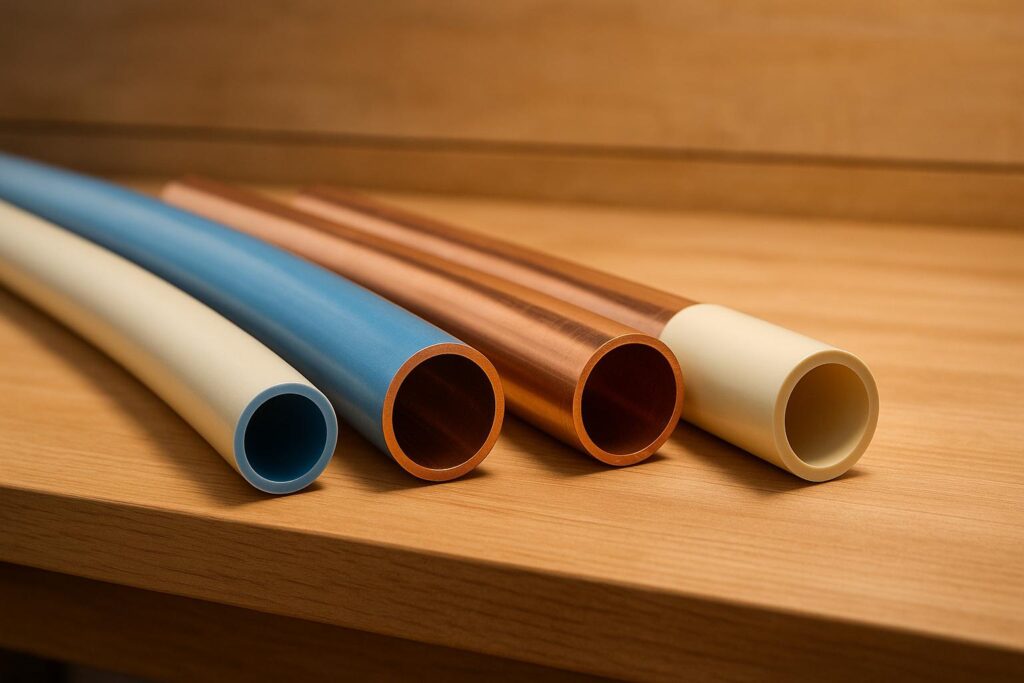
PEX (cross-linked polyethylene) costs between $0.50 and $2.00 per linear foot and has a lifespan of 30–50 years when installed properly. Its flexibility makes it ideal for navigating walls and tight spaces, cutting down on the need for extra fittings. This not only reduces material waste but also saves labor time. PEX resists scaling and chlorine well and can handle some expansion during freezing conditions, lowering the risk of burst pipes.
Copper is priced at $2.00–$5.00+ per linear foot and can last 50+ years in favorable conditions. It’s fire-resistant and naturally antimicrobial, which are significant advantages. However, copper installation is more labor-intensive, as it requires precise cutting, cleaning, and either soldering or press-fitting. In areas with aggressive water chemistry, copper might develop pinhole leaks over time, which is something to consider.
CPVC (chlorinated polyvinyl chloride) typically costs $0.50–$2.00 per linear foot and lasts 25–50 years. It’s a budget-friendly option that works well for both hot and cold water lines, using solvent-weld joints instead of soldering. However, its rigidity can make it harder to install in tight spaces, and it’s more prone to cracking under stress, high temperatures, or prolonged UV exposure.
| Material | Cost per Linear Foot | Typical Lifespan | Installation Ease | Best For |
|---|---|---|---|---|
| PEX | $0.50–$2.00 | 30–50 years | Flexible, quick installation with fewer fittings | Whole-house repipes, tight spaces, cost-conscious projects |
| Copper | $2.00–$5.00+ | 50+ years | Labor-intensive, requires soldering or pressing | High-durability needs, exposed mechanical areas |
| CPVC | $0.50–$2.00 | 25–50 years | Moderate, uses rigid solvent-weld joints | Accessible spaces like basements, budget repairs |
For many homeowners, PEX strikes the best balance between affordability and reliability. Its flexibility makes it a great choice for retrofitting older homes or working around obstacles. Copper, while more expensive, is a solid option for exposed areas or near water heaters where its durability and heat tolerance shine. CPVC is a practical choice for accessible areas like basements, though its rigidity can be a drawback in more confined spaces.
Weigh Upfront Costs Against Future Savings
Once you’ve compared materials, think beyond the initial price tag. While cheaper materials might seem appealing, they can lead to higher long-term costs due to repairs or replacements. Investing in a durable system like PEX can help reduce water waste – by as much as 10% – and lower the chances of future maintenance issues.
Instead of focusing solely on the upfront cost, consider the total lifecycle cost. Spending a bit more on quality materials and proper installation now can save you from costly repairs and potential water damage down the road.
Don’t forget to factor in local conditions like building codes, water chemistry, and climate. For homeowners in Round Rock, Texas, consulting a trusted provider like Round Rock Plumbing can make all the difference. Their expertise, combined with advanced tools like drain camera inspections, ensures you’ll find the most cost-effective and suitable pipe replacement solution for your home.
Determine How Much Pipe Needs Replacing
When planning a pipe replacement, it’s not just about choosing the right materials – accurately defining the scope of the work can significantly impact your budget. One of the biggest cost factors is deciding whether to repipe your entire system or focus on specific problem areas. For a 2,000-square-foot home, full-house repiping typically costs between $3,000 and $16,000, while addressing a single damaged section might only set you back a few hundred dollars. To avoid unnecessary expenses, a thorough assessment of your plumbing system is crucial before making a decision.
Full House vs. Targeted Replacement
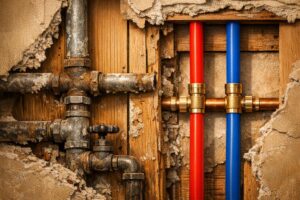
Go for full repiping if your entire system is compromised. Homes with galvanized steel, polybutylene, or older copper pipes – especially those over 50 years old – are often at risk of widespread corrosion and potential system failures. Warning signs like multiple leaks, persistently low water pressure, or discolored water suggest that patching individual sections won’t address the root of the problem.
Targeted replacement works well for isolated issues. If the damage is limited to a specific area, such as a leaking branch line in the bathroom, a corroded section behind a wall, or a failed kitchen supply line, you can often replace just that section without disrupting the rest of the system. While this option is more affordable upfront, connecting old pipes to new ones can sometimes lead to recurring leaks, so it’s not always a long-term solution.
Professional inspections are non-negotiable. Licensed professionals equipped with advanced diagnostic tools can provide a detailed assessment, helping you decide between a full repiping or a localized repair. These inspections often uncover hidden issues that might otherwise go unnoticed. For example, Round Rock Plumbing offers detailed diagnostic services to give homeowners a clear understanding of their plumbing system, ensuring the most cost-effective solution is chosen.
Trusting licensed experts for inspections and multiple evaluations ensures you replace only what’s necessary, saving both time and money in the long run.
Get Professional Inspections and Compare Quotes
Once you’ve chosen cost-efficient materials and outlined the scope of your project, the next step is to ensure your budget stays on track with professional inspections and detailed quotes. Inspections by licensed professionals help pinpoint exactly which pipes need attention, saving you from unnecessary full-system replacements or overspending. By relying on accurate diagnostics, you avoid costly guesswork and focus only on the repairs that are truly needed.
To get a clear picture of costs, gather at least three itemized quotes from licensed plumbers. These quotes should break down labor, materials, equipment fees, and any additional charges. This level of detail not only helps you spot inflated costs but also ensures you’re comparing estimates fairly. With a solid understanding of what’s required, you’ll be better equipped to make informed decisions about your plumbing project.
Use Advanced Inspection Tools
Modern technology can make a big difference when it comes to inspections. Tools like drain cameras and electronic leak detection can identify problem areas with precision. These techniques, especially when paired with trenchless repair methods, can cut costs by 30–40% compared to traditional open-trench replacements, as they reduce the need for extensive digging and surface restoration.
Drain cameras can detect internal issues like cracks, corrosion, and blockages, while electronic leak detection homes in on hidden leaks. This data allows plumbers to provide quotes based on the actual condition of your system, rather than educated guesses. For example, trusted professionals like Round Rock Plumbing utilize these advanced tools to give homeowners a clear understanding of their plumbing needs. In many cases, this approach enables sectional point repair – addressing only the damaged portion of a pipe – rather than replacing an entire line unnecessarily.
Accurate inspections not only eliminate uncertainty but also give you the confidence to evaluate quotes and choose the best course of action.
Review Quotes to Spot Hidden Fees
When reviewing quotes, insist on itemized details that cover all aspects of the job, including demolition, hauling, permits, materials, and restoration work. Avoid vague or lump-sum pricing, as these make it difficult to compare estimates or identify hidden fees.
Be on the lookout for common extra charges like permit fees (usually ranging from $100 to $500), disposal costs for old pipes, equipment rentals, and site restoration expenses. Ask each plumber whether their quote is a flat rate or based on time and materials. Also, clarify what happens if unexpected issues arise during the project. Make sure to ask who handles permit applications and whether there are additional fees for emergency or after-hours work.
Getting all terms in writing before the project starts protects you from surprise charges that could add hundreds – or even thousands – of dollars to your final bill. Detailed planning and clear communication with your plumber can save you from financial headaches down the line.
sbb-itb-5fe396b
Plan Your Project Timing and Site Access
Timing your pipe replacement thoughtfully can significantly cut labor costs and limit property damage. Here’s how to fine-tune your scheduling and site setup to save even more.
Schedule During Slower Seasons
Plumbing contractors are busiest in spring and summer, but demand drops sharply from November to February. Scheduling your project during this slower period can help you secure labor rates that are 10–20% lower. Plus, contractors are likely to dedicate more attention to your project during these off-peak months. This approach works hand in hand with choosing affordable materials and methods. Tackling pipe issues before winter can also save you from costly emergency repairs, which might range from $696.68 to $4,180.08 for burst pipes – and that’s not counting water damage restoration, which can climb as high as $22,293.76.
If you’re planning other renovations, like a kitchen or bathroom remodel, consider combining projects. Bundling tasks can reduce both labor and restoration costs.
Reduce Property Damage and Repair Costs
Preparing your site properly is just as important as picking the right materials. Before work begins, clear the area of any obstacles and ensure the main water shut-off valve is easy to access for the crew.
For outdoor projects, trim back nearby plants and remove any fragile decorations to prevent unnecessary damage. Let your contractor know which outdoor features need special care to avoid additional repair expenses.
Trenchless methods, such as pipe lining and pipe bursting, are excellent options for minimizing damage. These techniques avoid extensive digging, which helps keep restoration costs down. For example:
- Pipe lining involves creating a new pipe within the old one and typically costs between $111.47 and $348.34 per foot.
- Pipe bursting is ideal for completely collapsed pipes and can often be completed in just a few hours.
If you’re in Round Rock, Texas, consulting professionals like Round Rock Plumbing can provide personalized guidance. They can help you plan your project schedule and ensure smooth site access, all while protecting your property during the replacement process.
Use Modern Installation Methods
Modern installation techniques are a game-changer when it comes to keeping costs down while ensuring quality results. By leveraging strategies like targeted repairs and scheduling work during off-peak times, you can save both time and money. Two standout methods – trenchless pipe replacement and flexible PEX piping – offer practical solutions that reduce labor and restoration costs without compromising reliability.
Trenchless Pipe Replacement Methods
Trenchless pipe replacement eliminates the need for large-scale digging, which is a hallmark of traditional pipe repair. Instead of tearing up your yard or driveway, plumbers use small access points at either end of the damaged pipe. This streamlined approach significantly reduces the time spent on excavation and nearly eliminates the need for costly surface restoration.
Pipe bursting is one trenchless technique where the old pipe is broken apart while simultaneously installing a new one. It’s especially effective for long pipe runs that pass under driveways, lawns, or established landscaping. On the other hand, pipe lining involves inserting a resin-coated liner into the existing pipe, which then cures into a new pipe inside the old one. This method shines in situations where access is tricky, like pipes located under concrete slabs, patios, or streets, and when the pipe’s overall structure is still intact despite cracks or leaks.
The cost savings here are significant. Traditional methods often involve cutting through driveways, hauling away debris, trenching, and then repouring and finishing concrete – a process that can add thousands of dollars in labor and material. Trenchless methods avoid most of these steps, requiring only small pits near the curb and house, which preserve your driveway and yard while cutting down project timelines. Indoors, these methods also bypass the need for noisy, dusty slab demolition, making the process far less disruptive.
However, trenchless techniques aren’t always the best fit. For pipes with severe collapses, sharp bends, or very shallow runs, traditional trenching might actually be more practical and cost-effective – especially in open dirt or unfinished basement spaces where access is straightforward, and surface restoration is minimal. When combined with careful planning, trenchless methods can seamlessly fit into a cost-efficient pipe replacement strategy.
Install Flexible PEX Piping
Another way to save on labor and restoration costs is by using flexible PEX piping. Unlike rigid materials like copper, PEX is highly flexible, making it quicker and easier to install. Plumbers can bend it through tight spaces, which reduces the need for numerous fittings and minimizes the amount of repair work required afterward.
When comparing costs, copper repiping typically ranges from $8,000 to $15,000, while PEX installations average between $3,500 and $7,000. The savings primarily come from reduced labor hours and less demolition. PEX can be installed in continuous runs from manifolds to fixtures, which eliminates many of the connections that would otherwise need to be soldered or glued with other materials. This streamlined process translates to lower labor costs and fewer restoration expenses.
PEX is particularly advantageous for whole-house repiping in older homes with outdated galvanized steel or aging copper pipes. In homes with finished walls and ceilings, PEX allows for smaller access holes and faster installations compared to copper. For a 1,500–2,000 square foot home, replacing old galvanized pipes with PEX can often be completed more quickly and with less disruption, especially in areas where labor costs for drywall and painting are high.
For homeowners in Round Rock, Texas, professionals like Round Rock Plumbing can design efficient PEX layouts using manifolds to shorten pipe runs, reduce the number of fittings, and limit exposure in unconditioned spaces. When paired with trenchless methods for exterior lines, this approach not only keeps projects within budget but also minimizes disruptions to your yard, driveway, and home interiors.
Think Beyond Immediate Costs
When considering pipe replacement, it’s easy to focus solely on upfront installation expenses. But the real value often lies in the long-term benefits – fewer repairs, lower water bills, and a reduced risk of emergencies. Modern piping systems, such as PEX and copper, are designed to last 40–50 years when installed correctly. This durability means less frequent repairs and lower overall costs over time, complementing the initial savings discussed earlier.
Lower Maintenance and Fewer Emergency Calls
Older pipes made from materials like galvanized steel or cast iron are notorious for problems like internal corrosion, mineral buildup, and pinhole leaks. These issues demand constant attention and frequent repairs. On the other hand, modern materials are engineered to resist such problems, leading to fewer service calls and lower repair expenses. Emergency repairs, in particular, can be incredibly costly – not to mention the added financial burden of addressing water damage, mold removal, or even temporary housing [2,9]. By contrast, routine preventive maintenance typically costs just a few hundred dollars annually, a fraction of the expense of dealing with emergencies.
In addition to lower maintenance costs, upgrading your pipes can also lead to significant savings on your water bills.
Cut Water Bills with Better Efficiency
Replacing old, leaking pipes can stop unnoticed water loss that silently drives up your utility bills. New pipes ensure that fixtures and appliances operate as intended, which reduces water waste and lowers monthly charges [3,5]. In fact, addressing leaks and replacing inefficient lines can cut water bills by about 10%, with savings adding up significantly over 10 to 15 years. For even greater efficiency, consider pairing new pipes with low-flow fixtures and energy-efficient water heaters. This combination can reduce water usage by 30% to 50%, saving thousands of gallons each year while improving hot water delivery and cutting energy waste [2,4,24].
For homeowners in Round Rock, Texas, collaborating with experienced professionals like Round Rock Plumbing can make all the difference. They can help design efficient layouts and choose the best materials to maximize both immediate and long-term benefits, ensuring your investment pays off for decades to come.
Conclusion
Saving money on pipe replacement hinges on making smart decisions at every step of the process.
It begins with choosing the right materials – ones that suit your home’s requirements without overspending upfront or risking early failures. Deciding between a full-house replacement or targeted repairs is equally important, as the wrong choice could cost you thousands unnecessarily.
Timing is also key. Scheduling your project during less busy periods for contractors or aligning it with other planned renovations can significantly lower labor expenses. Additionally, modern trenchless methods, which can cut excavation costs by 30–40%, offer a cost-effective solution while ensuring decades of dependable performance.
The financial benefits don’t stop at installation. Upgraded piping systems, with lifespans of 40–50 years, reduce the need for emergency repairs, minimize ongoing maintenance, and help conserve water. Pairing these systems with water-efficient fixtures can further lower water consumption by 30–50%, leading to noticeable savings on monthly bills.
For homeowners in Round Rock, Texas, Round Rock Plumbing provides advanced diagnostics to ensure you replace only what’s necessary and select the most cost-effective methods for your unique needs.
FAQs
What are the advantages of trenchless pipe replacement?
Trenchless pipe replacement has become a go-to solution for many homeowners and property managers – and for good reason. One of its standout benefits is that it skips the need for large-scale digging. That means your landscaping, driveways, and outdoor spaces stay intact, sparing you the headache (and cost) of restoring your property afterward.
Another perk? It’s much quicker than traditional pipe replacement methods. Less time spent on the job means fewer disruptions to your daily routine. Plus, trenchless technology uses modern, durable materials built to last for decades, giving you a long-term fix for your plumbing issues. If you’re exploring pipe replacement options, this method offers an efficient and budget-friendly alternative worth considering.
How do I know if I need to replace all my pipes or just fix specific areas?
When deciding between a full pipe replacement or targeted repairs, it’s important to evaluate the scope of the issue. If you’re dealing with multiple leaks, extensive corrosion, or persistent drops in water pressure, it’s often a sign that full repiping might be necessary. However, if the problem is limited to one specific area, such as a single damaged section, targeted repairs are usually enough to fix the issue.
If you’re uncertain about the best approach, consulting a professional plumber is a smart move. They can assess the condition and age of your pipes and provide guidance on the most effective solution. This way, you can tackle the issue without spending more than you need to.
What should I keep in mind when deciding between PEX, copper, and CPVC pipes for replacement?
When deciding between PEX, copper, and CPVC pipes, it’s essential to weigh factors like durability, cost, and the unique requirements of your home or property.
- PEX is a flexible, freeze-resistant option that’s often more affordable, making it a go-to choice for many homeowners.
- Copper stands out for its durability and longevity, but it comes at a higher price and may require professional installation.
- CPVC offers a budget-friendly solution, resists corrosion, and handles both hot and cold water well. However, it’s less reliable in extreme temperatures.
Each type of pipe has its strengths and weaknesses. Consulting a professional plumber can help you determine the best choice for your budget, local climate, and plumbing system. Round Rock Plumbing specializes in pipe replacement and can guide you through selecting the right material for your specific needs.
Related Blog Posts
Need a Plumber in Round Rock?
Get fast, reliable service from licensed professionals.
Or call us now: (512) 598-4241